Showing posts with label trig. Show all posts

Friday, November 28, 2014

Inscribed Triangles and the Law of Sines


The Law of Sines follows from the following fact:  

Theorem: Any side of a triangle divided by the sine of the opposite angle gives the diameter of the circumscribing circle.

In other words, \( \frac{a}{\sin \alpha}, \frac{b}{\sin \beta}\), and \(\frac{c}{\sin \gamma} \) are all equal because each represents the same diameter.

The Law of Sines can be proven by using the fact that the area of a triangle is half the product of any two sides and the sine of the included angle. But such a proof gives no hint of the geometric interpretation of \( \frac{a}{\sin \alpha}\).

Here's a geometric argument for the theorem.

Case 1: First, we notice that if we have a right triangle with hypotenuse \(c\), then \(\sin\alpha =\frac{a}{c}\), \(\sin\beta =\frac{b}{c}\), and \(\sin\gamma =\sin 90^{\circ}=1\), so all three ratios  \( \frac{a}{\sin \alpha}, \frac{b}{\sin \beta}\), and \(\frac{c}{\sin \gamma} \)  are equal to \(c\), the hypotenuse. And because an inscribed right angle subtends an arc of \(180^{\circ}\), the hypotenuse coincides with a diameter. Thus the theorem is true for all angles in any right triangle.

Case 2: Now suppose that \(\Delta ABC\) is a triangle with \(\alpha =\angle CAB\) an acute angle. Draw the diameter through \(B\) to the point \(D\), and draw the segment from \(D\) to \(C\).


\(\Delta DBC\) is a right triangle inscribed in the same circle and shares the side of length \(a\) with \(\Delta ABC\). The angle at \(D\) subtends the same arc as the angle at \(A\), so the angles are congruent. By Case 1, \(\frac{a}{\sin\alpha}\) is the diameter of the circumscribing circle. Thus the theorem holds for any acute angle in any triangle.

Case 3: Now suppose that  \(\Delta ABC\) is a triangle with \(\alpha =\angle CAB\) an obtuse angle. Choose \(D\) so it lies on the arc of the circle subtended by \(\angle CAB\). Then \(\Delta DBC\) is inscribed in the same circle as \(\Delta ABC\) and shares the side of length \(a\).

Because \(\angle CAB\) and \(\angle CDB\) subtend arcs that sum to \(360^{\circ}\), they are supplementary angles. In particular, \(\angle CDB\) is acute, so the diameter of the circumscribing circle is \(\frac{a}{\sin(180^{\circ}-\alpha)}\). And because \(\sin(180^{\circ}-\alpha) = \sin\alpha\), we conclude that the diameter of the circumscribing circle is  \( \frac{a}{\sin \alpha}\).

Thus, whether \(\alpha\) is a right angle, acute angle, or obtuse angle, the ratio  \( \frac{a}{\sin \alpha}\) gives the diameter of the circumscribing circle.

Tuesday, August 5, 2014

What Math is Needed by All?


The (California version of the) Common Core State Standards in mathematics purport to be what all students need to be college and career ready.

The quantifier "all" in this context indicates that the math content should be the intersection (over all students) of math a student needs to be ready to begin college (or begin a career). Critics of the CCSSM who decry that the standards are not enough to prepare a student for an elite university such as Stanford are missing the point. The intent of the CCSS was never to include the union (over all students) of the math that a student needs to succeed in college. (And if the CCSS could provide all the math and English Language Arts that Stanford students need, then Stanford would not deserve its status as an elite school.)

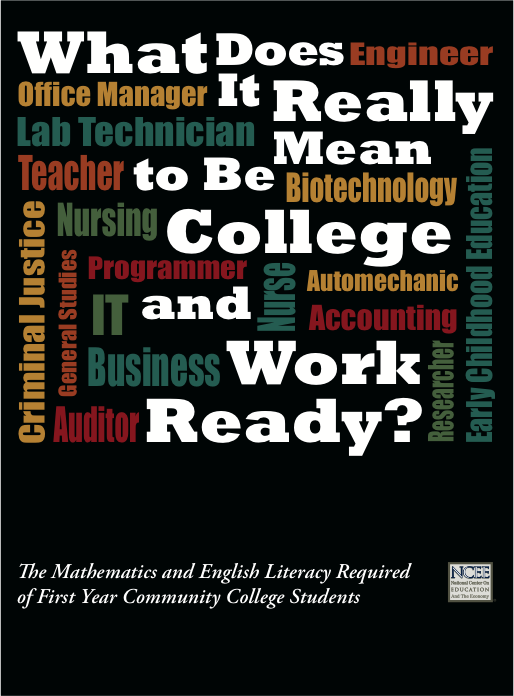
And what do all students need? In 2013, the National Center on Education and the Economy released a study What Does It Really Mean to Be College and Work Ready?, reporting on both mathematics and English literacy. The report says, "Mastery of Algebra II is widely thought to be a prerequisite for success in college and careers. Our research shows that that is not so... Based on our data, one cannot make the case that high school graduates must be proficient in Algebra II to be ready for college and careers."

California's Intersegmental Committee of the Academic Senates (ICAS) represents the faculty academic senates of the three CA systems of higher education: the University of California (UC), the California State University (CSU), and the California Community College (CCC) system. The ICAS Statement on Competencies in Mathematics Expected of Entering College Students, revised in 2013, describes a number of mathematical topics that are or could be taught in high schools.

The ICAS competency statement describes mathematical subject matter in four categories: Part 1: Essential areas of focus for all entering college students, Part 2: Desirable areas of focus for all entering college students, Part 3: Essential areas of focus for students in quantitative majors, and Part 4: Desirable areas of focus for students in quantitative majors.

The mathematics that the CCSSM describe as what all students need should presumably match with what the ICAS statement describes as "essential" and lists in Part 1. But although the UC Board of Admissions and Relations with Schools (BOARS) states there is "close alignment" between the CCSS and the ICAS statement, the ICAS statement makes clear that there are many CCSS that are not "essential" but rather merely desirable or for only some students. Appendix B of the ICAS statement explicitly shows where Part 2, 3, and 4 areas of math are found in the CCSS (and NCTM standards).

And the Interim Environmental Scan Report to The Common Assessment Initiative Steering Committee has in  Appendix B a Table that shows a number of CCSS that do not occur at all in the ICAS statement.

Here are examples of CCSSM topics that might surprise some community college math faculty, especially those who believe that intermediate algebra as currently taught will be sufficient to cover all the CCSSM.
  • Probability:  sample spaces, independent events, conditional probability, permutations and combinations; analyzing decisions and strategies using probability
  • Statistics: assessing the fit of a function by plotting and analyzing residuals; interpreting the correlation coefficient of a linear model in context; normal distributions, random samples, estimating population parameters, simulations, using probability to make decisions
  • Transformational geometry: congruence defined in terms of rigid motion; similarity defined in terms of dilations and rigid motions
  • Trigonometry: trig ratios, special angles, 6 trig functions of real numbers; modeling periodic phenomena, proof and use of the Pythagorean trig identity \( \cos^2 \theta + \sin^2 \theta = 1 \)

Tuesday, August 7, 2012

CCSS and Community College Math Programs


We may need a complete redesign of the developmental math program in US two-year colleges.

My campus currently uses a placement test (Mathematics Diagnostic Test Project) to determine if students are ready for transfer level courses (math for elementary school teachers, stats, trig, precalculus, calculus)  or what remedial course (arithmetic, prealgebra, elementary algebra, intermediate algebra) they should take.

But the Common Core State Standards for mathematics will have high school students studying mathematics organized in a fashion that does not align with our existing math courses.

California is one of the 45 states that have formally adopted the CCSS for mathematics, and I am on a recently appointed state committee whose charge is to align California’s math standards (a.k.a. the California Framework) with the CCSS.

One of the main reasons that I applied to be on the Mathematics Curriculum Framework and Evaluation Criteria Committee (MCFCC) was to better familiarize myself with what is to be taught in California's K-12 schools.  (Another reason was to lose myself in abbreviations:  SBE for State Board of Education, CDE for California Department of Education, IQC for Instructional Quality Commission, the body that forwarded my name to the SBE for approval to serve on the MFCC to align the CF with the CCSS.)

The CCSS specify a consensus of what math is required for students to be college or career ready.  The standards are grouped into six conceptual categories:  Number and Quantity, Algebra, Functions, Modeling, Geometry, and Statistics and Probability.  (There are separately eight standards for mathematical practice that go across all grade levels.)

The CCSS differ significantly from what is typically required for graduation in most American high schools today.  For example, the treatment of statistics and probability includes not only descriptive statistics but also conditional probability, inference, decisions based on probability, and rules of  probability. 

The CCSS include not only right-triangle trigonometry but also trig functions of a real variable, to be used in modeling periodic behavior.  Thus trig spans the geometry, algebra, and function categories.

The CCSS gives math standards for high school without specifying courses or order of topics.  But evidently the introduction of functions includes an emphasis on (linear and) exponential functions with domains restricted to a subset of the integers--sequences are explicitly studied as functions.

California community colleges do not require a high school diploma for admission.  A student who masters the first CCSS high school math course will already have compared exponential functions with linear functions and solved equations both algebraically and graphically. The student will have had explicit instruction on descriptive statistics.  The student may have worked with constructions and transformations in the plane and proved simple geometric theorems algebraically but not yet worked with polynomials (and specifically not with quadratic functions or quadratic equations).

How will our placement system advise this student?

One of the recommendations  of California's Student SuccessTask Force is for better alignment between high school and college curricula.  With the CCSS adopted across states, it looks as if most community colleges will need to make adjustments to their way of placing and educating their math students.

Wednesday, December 28, 2011

sin(n) is dense in [-1,1]


Numbers of the form sin(n) get arbitrarily close to every real value from -1 to 1.

Consider the integers mod(2pi).   Equivalently, we can consider the points (cos n, sin n) on the unit circle (a.k.a. using the "wrapping function").   Because we have an infinite set of points in a compact set, there must be an accumulation point. 

For any epsilon > 0, we can find distinct integers m and n such that  (cos m, sin m)  and  (cos n, sin n)  are less than epsilon apart on the circle, so  (cos(m-n), sin(m-n))  is within epsilon of (1,0).   Then (by say the Archimedean principle),  every point on the unit circle is within epsilon of some integer multiple of (m-n) wrapped around the unit circle .   Thus the points of the form (cos k, sin k)  form a dense subset of the unit circle.  In particular, numbers of the form sin(k) form a dense subset of [-1,1].

A slightly different argument for density of sin(n) depends on the following lemma.

Lemma:  If x is irrational, then the additive group Z + xZ is dense in R.

If we accept the lemma, then the additive group Z + (2pi)Z is dense in R, so the points (cos t, sin t) for t in Z + (2pi)Z must be dense in the unit circle.  But (cos (n+m2pi), sin (n+m2pi)) = (cos n , sin n), so (cos n , sin n) is dense in the circle.

To prove the lemma, consider the contrapositive and assume that Z + xZ is discrete.  Then Z + xZ must be cyclic:  Z + xZ = dZ for some real number d.  Because Z is contained in dZ, there must be some integer n so that 1 = nd, hence d = 1/n is rational.  And then for some m, 1+x = m/n, so x is rational.

And the converse of the lemma is also true, because of x = m/n is rational, then Z + xZ =  1/n Z.

Monday, December 7, 2009

Generating Pythagorean Triples


The 5 millennia old clay tablet designated Plimpton 322 contains a trig table. The second and third columns represent a leg and hypotenuse of a right triangle with positive integer sides. The rows are arranged in approximately equal steps of angle.

The existence of such a table suggests that the Babylonians were adept at producing Pythagorean triples (integers a, b, and c satisfying a2 + b2 = c2), a trick which is also useful to many algebra, geometry, and trig teachers attempting to create exercises with nice values.

Every positive Pythagorean triple can be generated by choosing positive integers u and v with u > v and setting a = 2uv, b = u2 - v2, and c = u2 + v2 (or by scaling such a triple by a positive integer). We'll derive that fact below. (Pythagorean triples with no common factor are called primitive Pythagorean triples, and all the primitive Pythagorean triples are generated when u and v are relatively prime with exactly one of them being odd.)

It's straightforward to verify that the a, b, and c so defined do form a Pythagorean triple. And conversely, if a, b, and c form a Pythagorean triple, then (a/c, b/c) is a point on the unit circle x^2+y^2=1, so the positive Pythagorean triples can be mapped onto the rational points of the unit circle that lie in the first quadrant.

The line y = 1 + mx will intersect the unit circle at (0,1) and also at a point in the first quadrant when the slope m is between -1 and 0. In fact, we can find the x-coordinate of the second intersection point by solving the equation x2 + (1 + mx)2 = 1--we find that x=\frac{-2m}{1+m^2}, so y=1-\frac{2m^2}{1+m^2}.

Thus the second intersection point is a rational point if m is rational. Of course the slope between (0,1) and any rational point on the unit circle is rational, so we have a 1-1 correspondence between positive rational points on the unit circle and rational slopes between -1 and 0.

We now assume that m is a rational number between -1 and 0, so we can write m = -v/u, where u and v are positive integers with u > v. Then the second intersection point we found above has the form

\left(\frac{-2(\frac{-v}{u})}{1+(\frac{-v}{u})^2}, \,\, 1- \frac{2(\frac{-v}{u})^2}{1+(\frac{-v}{u})^2}\right) = \left(\frac{2uv}{u^2+v^2}, \frac{u^2-v^2}{u^2+v^2}\right).

Thus every rational point on the unit circle can be written in this form. In particular, every primitive Pythagorean triple a, b, and c can be expressed as above in terms of u and v.