Showing posts with label developmental. Show all posts

Tuesday, June 7, 2016

"Unjustified use of Algebra 2"

The U.S. Department of Education organized a meeting (“California Math Convening: Gateways to Access – May 31, 2016”) to discuss California's use of Algebra 2 (a.k.a. Intermediate Algebra) in higher education. The meeting was held at the chancellor's office of the California State University (CSU) system. The participants included representatives from the CSU, the University of California, the California Community Colleges, K-12 educators, and educational policy organizations.

The meeting was the DOE's response to a September 30, 2015 letter from Christopher Edley, Jr., to the Catherine Lhamon, Assistant Secretary of Civil Rights, U.S. Department of Education. The letter begins with:
“I write to request that your office investigate the educationally unjustified use of Algebra 2 as a gateway course by all three segments of California’s higher education system: the University of California system; the California State University system; and the California Community College system. There is evidence to suggest that, in varying ways, these institutions have adopted policies and practices that impose a disparate impact on protected groups in violation not only of the equal protection clause of the California State Constitution, but also in violation of federal regulations implementing Title VI of the Civil Rights Act of 1964.”
The letter cites the success of Statway, a project of the Carnegie Foundation for the Advancement of Teaching, as evidence that Intermediate Algebra is not actually necessary for success in completing math requirements for baccalaureate degrees in some majors. The letter concludes with:
“If there are villains here, they are the indifference and inertia that confirm and perpetuate unequal educational opportunity. I believe this discrimination is, for the most part, without animus. Regardless, the injury is real.” 
At the meeting, Christopher Edley Jr. explained that neither intent nor a history of practice would be considered relevant when determining if there is a violation of the Civil Rights Act. The presence of both Catherine Lhamon and also the Under Secretary U.S. DOE, Ted Mitchell, made abundantly evident that the DOE wants California's higher education community to recognize and address the issue.

Another speaker was William McCallum, mathematician with numerous distinctions including being one of the three lead writers of the Common Core State Standards in Mathematics (CCSSM). Bill explained that because College Algebra was the de facto mathematics requirement in U.S. baccalaureate granting institutions at the time of writing the CCSSM, the document needed to include the math that would lead to College Algebra, namely Algebra 2. He commented that it is  inappropriate for colleges or universities to cite the CCSSM to define what is currently needed to be college ready--it makes no sense to argue against modifying college math requirements based on the content of the CCSSM, as the CCSSM were created trying to reflect what the earlier college math requirements had been.

The U.S. DOE evidently intends to hold another such meeting in 3 or 4 months to check on what progress has been made.

Saturday, February 7, 2015

Strategies to help developmental math students

Nationally about 70% of incoming community college students are placed into developmental (a.k.a. “remedial” or “foundational”) math classes that earn no college degree credit. But only 10% of these students successfully move past developmental math to earn their degrees.


Four broad areas are being addressed to increase student success through developmental mathematics (1) Placement, (2) Pedagogy, (3) Curriculum, and (4) Student attitudes.


Improving Placement
Failing a class is not the only barrier to completion--the length of the developmental math path defeats many students. More developmental math students drop out of college without ever failing a math class than flunk out of math. One strategy to reduce the number of “exit points” is to help students place into as high a math level as reasonable.


For example, CaƱada College uses its Math Jam both as an intensive preparation for the math placement exam and also as a recruitment tool to get more students into STEM fields.


The placement instrument itself, typically a machine-graded standardized test, can be augmented or replaced.  High school GPA, recency of the previous math course, weekly work hours, and total course load could be part of “multiple measures.” Some schools have abandoned placement into developmental math courses, typically offering supplementary resources for students in credit-bearing classes.


Modifying Pedagogy
James Stigler lists three key types of learning opportunities that students need to experience to become flexible learners: productive struggle, explicit connections, and deliberate practice.

Modularized courses can allow students to spend time only on topics they need to study. The Emporium Model relies on software to do the pretest, primary instruction, and mastery testing, with human interaction largely limited to one-on-one tutoring in the computer lab (where students work lessons and take assessments). The University of Illinois uses software for placement and remediation, and California State University Northridge uses software as part of its hybrid lab remediation for students considered “at risk.”


Technology also plays a key role in both MOOCs (Massive Open Online Courses) and the “flipped” classroom. However, the “MO” aspects of MOOCs appear not to improve student success compared with the online developmental math courses that have existed for decades.


Another way to address the attrition between courses in a sequence is to offer “compressed” courses. The students take two courses during one term, but each course meets the standard number of hours per term--students are essentially immersed in math, which comprises most or all of their studies for that term.


Adjusting the Curriculum
The American Mathematical Association of Two-Year Colleges (AMATYC) has a 2014 position paper that states, “Prerequisite courses other than intermediate algebra can adequately prepare students for courses of study that do not lead to calculus.”


There are numerous “pathways” that have been created to allow developmental math students to pass a transferable math course--typically statistics or a quantitative reasoning course--that do not require many topics typically associated with intermediate algebra. The pathways normally reduce the number of developmental math courses required before earning transferable math units.
  • Path2Stats is part of the California Acceleration Project, based on a program developed by Myra Snell at Los Medanos College.
  • Statway and Quantway are projects of the Carnegie Foundation for the Advancement of Teaching.
  • The Dana Center’s Math Pathways include pathways for both STEM and non-STEM students.
  • Mathematical Literacy for College Students (MLCS) and Algebraic Literacy grew out of an AMATYC project. They can serve as alternatives to beginning and intermediate algebra classes for STEM majors, or the MLCS  can serve as prerequisite for a transferable non-STEM math course.


Addressing student attitudes
The “affective domain” includes attitudes, values, beliefs, interests, and motivation.


Carol Dweck’s research indicated that students (from grade school through graduate school) with “growth mindsets” persist and succeed better than peers with “fixed mindsets”. And importantly, students can learn to move from a fixed mindset to a growth mindset.

David Yeager’s research suggests that the performance gap in math--specifically developmental math--suffered by women and other underrepresented groups can be eliminated by specific brief interventions.

City University of New York's Accelerated Study in Associate Programs (ASAP) is an initiative that does not attempt to modify what occurs in the classroom. ASAP stipulates full-time enrollment and provides participants with academic advisement, career services, tutoring, financial supports, specially blocked or linked courses.

Tuesday, September 9, 2014

Higher Education Alignment with the Common Core

The August 29, 2014 letter from California's higher education top administrators  announced that "the a-g requirements for CSU and UC admission, specifically areas ‘b’ (English) and ‘c’ (Mathematics), have been updated to align with the Common Core standards."

How that alignment will look is not specified in the letter.

As of today (9/9/14), the UC Mathematics ("c") subject requirements listed publicly do not show alignment with the Common Core State Standards. Instead, they still show expectations of California standards that existed before the CCSSM. For example, in item 2 of Course requirements, "The content for these courses will usually be drawn from the Common Core State Standards for Mathematics [PDF]. While these standards can be a useful guide, coverage of all items in the standards is not necessary for the specific purpose of meeting the 'c' subject requirement....The ICAS Statement of Competencies in Mathematics can provide guidance in selecting topics that require in-depth study." [Emphasis mine.]

A concern for California community colleges is that the alignment to the CCSSM might become what was proposed by the UC Board of Admissions and Relations with Schools (BOARS) in 2013. In July, BOARS wrote that “… the basic mathematics of the CCSSM can appropriately be used to define the minimal level of mathematical competence that all incoming UC students should demonstrate...As such, BOARS expects that the Transferable Course Agreement Guidelines will be rewritten to clarify that the prerequisite mathematics for transferable courses should align with the college-ready content standards of the CCSSM.”

BOARS clarified (December 2013) that “… going forward, all students must complete the basic mathematics defined by the college-ready standards of the Common Core State Standards for Mathematics (CCSSM) prior to enrolling in a UC-transferable college mathematics or statistics course.”

The college-ready standards of the CCSSM are simply all the non-plus standards. As written in the CCSSM“The higher mathematics standards specify the mathematics that all students should study in order to be college and career ready. Additional mathematics that students should learn in preparation for advanced courses, such as calculus, advanced statistics, or discrete mathematics, is indicated by a plus symbol (+). All standards without a (+) symbol should be in the common mathematics curriculum for all college and career ready students.” [Emphasis mine]

Thus BOARS has twice stated that it expects all UC students to have all the CCSSM non-plus standards as prerequisite to any course that could receive UC credit.

But what undermines BOARS's credibility is its assessment of how the ICAS statement of competencies and the CCSSM content standards compare. In the opening paragraph of the BOARS July letter: "The most recent version of the ICAS mathematical competency statement makes clear the close alignment between it and the CCSSM. Both define the mathematics that all students should study in order to be college ready." [Emphasis mine.]

In actuality, what ICAS considers essential math content for all students is only a small subset of what the CCSSM specify as necessary. The ICAS document lists four sets of possible high school math topics. The first is Part 1: Essential areas of focus for all entering college students. Appendix B of the ICAS document explicitly shows how the CCSSM include not only the math topics of Part 1 but also the math topics of Parts 2, 3, and 4, which are areas of focus for students in quantitative majors or are areas of focus considered desirable but not essential.

Tuesday, August 5, 2014

What Math is Needed by All?


The (California version of the) Common Core State Standards in mathematics purport to be what all students need to be college and career ready.

The quantifier "all" in this context indicates that the math content should be the intersection (over all students) of math a student needs to be ready to begin college (or begin a career). Critics of the CCSSM who decry that the standards are not enough to prepare a student for an elite university such as Stanford are missing the point. The intent of the CCSS was never to include the union (over all students) of the math that a student needs to succeed in college. (And if the CCSS could provide all the math and English Language Arts that Stanford students need, then Stanford would not deserve its status as an elite school.)

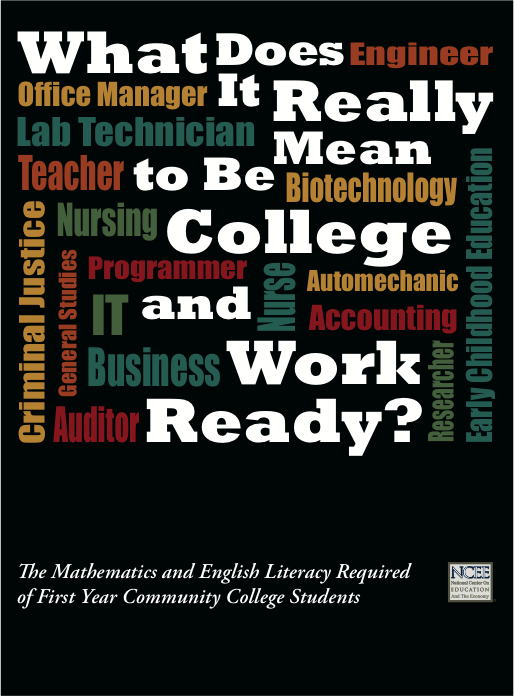
And what do all students need? In 2013, the National Center on Education and the Economy released a study What Does It Really Mean to Be College and Work Ready?, reporting on both mathematics and English literacy. The report says, "Mastery of Algebra II is widely thought to be a prerequisite for success in college and careers. Our research shows that that is not so... Based on our data, one cannot make the case that high school graduates must be proficient in Algebra II to be ready for college and careers."

California's Intersegmental Committee of the Academic Senates (ICAS) represents the faculty academic senates of the three CA systems of higher education: the University of California (UC), the California State University (CSU), and the California Community College (CCC) system. The ICAS Statement on Competencies in Mathematics Expected of Entering College Students, revised in 2013, describes a number of mathematical topics that are or could be taught in high schools.

The ICAS competency statement describes mathematical subject matter in four categories: Part 1: Essential areas of focus for all entering college students, Part 2: Desirable areas of focus for all entering college students, Part 3: Essential areas of focus for students in quantitative majors, and Part 4: Desirable areas of focus for students in quantitative majors.

The mathematics that the CCSSM describe as what all students need should presumably match with what the ICAS statement describes as "essential" and lists in Part 1. But although the UC Board of Admissions and Relations with Schools (BOARS) states there is "close alignment" between the CCSS and the ICAS statement, the ICAS statement makes clear that there are many CCSS that are not "essential" but rather merely desirable or for only some students. Appendix B of the ICAS statement explicitly shows where Part 2, 3, and 4 areas of math are found in the CCSS (and NCTM standards).

And the Interim Environmental Scan Report to The Common Assessment Initiative Steering Committee has in  Appendix B a Table that shows a number of CCSS that do not occur at all in the ICAS statement.

Here are examples of CCSSM topics that might surprise some community college math faculty, especially those who believe that intermediate algebra as currently taught will be sufficient to cover all the CCSSM.
  • Probability:  sample spaces, independent events, conditional probability, permutations and combinations; analyzing decisions and strategies using probability
  • Statistics: assessing the fit of a function by plotting and analyzing residuals; interpreting the correlation coefficient of a linear model in context; normal distributions, random samples, estimating population parameters, simulations, using probability to make decisions
  • Transformational geometry: congruence defined in terms of rigid motion; similarity defined in terms of dilations and rigid motions
  • Trigonometry: trig ratios, special angles, 6 trig functions of real numbers; modeling periodic phenomena, proof and use of the Pythagorean trig identity \( \cos^2 \theta + \sin^2 \theta = 1 \)

Tuesday, July 29, 2014

Schizophrenic Common Core Supporter


Back in 2012 Sol Garfunkel wrote "I feel like a schizophrenic. I truly think that the Common Core State Standards for Mathematics (CCSSM) are a disaster...So why do I feel like a schizophrenic? Because I am at the same time working to make the implementation of the CCSSM be as effective as possible!"

As mathematician Keith Devlin has emphasized, the heart of the CCSSM is the set of 8  standards of Mathematical Practice:

  • MP1. Make sense of problems and persevere in solving them.
  • MP2. Reason abstractly and quantitatively.
  • MP3. Construct viable arguments and critique the reasoning of others.
  • MP4. Model with mathematics.
  • MP5. Use appropriate tools strategically.
  • MP6. Attend to precision.
  • MP7. Look for and make use of structure.
  • MP8. Look for and express regularity in repeated reasoning.


It would be hard to imagine that any mathematician or math educator would not applaud these standards. And these standards, the key to the CCSSM and presented at the start of each set of grade level standards, are rarely if ever mentioned in the attacks on the CCSSM.

Much of the resistance to the CCSS is political: the Democratic President of the United States has endorsed the CCSS, so there is automatic opposition from the Tea Party, Republicans, and Libertarians, who argue that the CCSS is a federal program. But although President Obama is giving incentives for states to adopt the CCSS, the standards are the result of 48 state governors and secretaries of education agreeing to cooperate to create educational standards that would be consistent across state lines.

The resistance from the classroom teachers is understandable because they will be held accountable to how their students will do on the CCSS standardized testing. But the standardized testing that will be used is not part of the CCSS but rather is being created by SBAC or PARCC, consortia created to write CCSS assessments. That is, although the news media report teacher opposition to the CCSS, the teachers' actual objection is to the assessments and how they will be used.

The widely seen mocking and vilification of CCSS lessons by the public also confuse the CCSS with methods for testing students for mathematical proficiency. The CCSS explicitly require that students master the standard algorithms that critics mistakenly say are "real math" and missing from the CCSS. But significantly, the CCSS also require (MP1) that students can make sense of the mathematical tasks they are performing.

I think the CCSSM grossly overshoot the mark when trying to specify the math that all students need to be college and career ready. But like Sol Garfunkel, I think we should simultaneously embrace the CCSS and work to improve them.

Wednesday, July 23, 2014

Common Core Goes to College

The New America Foundation’s position paper by Lindsey Tepe gives recommendations for how higher education can support the Common Core State Standards. However, this paper and related articles in the Chronicle  and Hechinger Report  miss the most important way for higher education to support the CCSS, namely, to work to repair or ameliorate the existing flaws in the CCSS. 
cover of position paper

An implicit assumption in Tepe's paper is that the CCSS have successfully captured what all students need to be college and career ready. If the assumption is false, the paper is advocating moves to change higher education to accommodate inappropriate standards, changes that could harm students and impede their paths to college degrees.

The CCSS have missed the mark at what is necessary for all students to succeed in college.

Many of the non-plus CCSS are currently introduced to students in credit-bearing courses of baccalaureate granting institutions. That is, the CCSS overshoots what is needed to be ready for college and includes topics that are part of what some college students need to learn while in college.

The intent of the CCSS was to help get students college (and career) ready. It is an abuse of the CCSS to use those standards as an opportunity for colleges and universities to raise admissions and/or degree requirements, and that abuse will work against the goal of giving more students the opportunity to earn college degrees.

Thursday, July 17, 2014

Math Initiatives for Student Success

The LearningWorks paper Changing Equations: How Community Colleges Are Re-thinking College Readiness in Math, written by Pamela Burdman, is a nice summary of current initiatives attempting to help capable students negotiate developmental math needs to succeed in transfer-level mathematics.

Much of the paper discusses the strategy of alternative pathways. In this strategy, students pass a course that is identical to, or has the same content and rigor of, accepted transfer math courses, but instead of first passing an intermediate algebra course, the students take a math course designed specifically to prepare them for the transfer course—that preparatory course omits some standard topics of intermediate algebra which are not necessary to succeed in the transfer math course.

The initial data on alternative pathways, some cited in Changing Equations, show that a much higher percentage of students initially placed in a developmental math course can pass a transfer level math course following an alternative pathway than by following the traditional chain of prerequisites. 

But both the University of California and the California State University systems require that intermediate algebra be a prerequisite for any transferable course. Keeping the intermediate algebra prerequisite based on the data that have shown success in intermediate algebra is a predictor of college success is, as pointed out in Changing Equations, following the error of confusing correlation with causation, and in fact the widespread practice of requiring success in intermediate algebra (a.k.a. Algebra 2) as a admissions requirement virtually guarantees the high correlation that has been often noted.

Friday, July 26, 2013

More on Alternative Pathways and transferability in California

California's adoption of the Common Core State Standards in Mathematics (CCSSM) helps to shape the expectations of universities regarding the mathematical background of their incoming students.

The July 2013 statement (http://senate.universityofcalifornia.edu/committees/boars/BOARSStatementonMathforAllStudentsJuly2013.pdf) from the University of California's Boards of Admissions & Relations with Schools (BOARS) comments that most California Community Colleges (CCCs) continue to use "traditional Intermediate Algebra (i.e., Intermediate Algebras as defined prior to CCSSM implementation)" as prerequisite to a transferable mathematics course.

The BOARS statement continues, "Specifying that transferable courses must have at least Intermediate Algebra as a prerequisite is not fully consistent with the use of the basic mathematics of the CCSSM as a measure of college readiness...Requiring that all prospective transfer students pass the current version of Intermediate Algebra would be asking more of them than UC will ask of students entering as freshmen who have completed CCSSM-aligned high school math courses. As such, BOARS expects that the Transferable Course Agreement Guidelines will be rewritten to clarify that the prerequisite mathematics for transferable courses should align with the college-ready content standards of the CCSSM."


Meanwhile, the Academic Senate of California Community Colleges (ASCCC) has endorsed the CCSSM, but has no formal position on alternative pathways.  A Fall 2012 resolution to support innovations to improve success in under-prepared non-STEM pathways was referred to the executive committee.  However, former ASCCC president Ian Walton did publish in the ASCCC Rostrum an opinion (http://asccc.org/content/alternatives-traditional-intermediate-algebra) that "The wide range of conversations demonstrates that a strong case can be made for the exploration and implementation of alternative preparations for transfer level math courses that differ from the content of the traditional intermediate algebra course."

Sunday, July 21, 2013

Alternative Pathways and transferability in California

California is home to the Carnegie Foundation for the Advancement of Teaching, the current force behind two pathway projects:  Statway and Quantway

An underlying assumption behind alternative pathways is that mathematics requirements for degrees and/or certificates should vary according to discipline. California's Student Success Task Force report contends, "Improved student support structures and better alignment of curriculum with student needs [Emphasis added] will increase success rates in transfer, basic skills, and career technical/workforce programs." The National Center on Education and the Economy 2013 report, "What Does It Really Mean to Be College and Work Ready?" states, "But our research...shows that students do not need to be proficient in most of the topics typically associated with Algebra II and much of Geometry to be successful in most programs offered by the community colleges."

The Carnegie Foundation, The Charles A. Dana Center at U.T. Austin, and the California Community College Success Network (3CSN) all promote alternative pathways to allow students in non-STEM disciplines an option of completing a university-transferable mathematics course without requiring the students to demonstrate completion of an intermediate algebra course.

The two California university systems, the University of California (UC) and the California State University (CSU) have been cautious in embracing the idea of alternative pathways in California Community Colleges (CCCs).

One pathway strategy is to provide students with an alternative  prerequisite to an existing transferable statistics class.  The alternative prerequisite does not have all traditional intermediate algebra topics and does not have elementary algebra as prerequisite. And in response to this strategy, Nancy Purcille of the UC Office of the President sent a March 7, 2013 email to CCC articulation officers:

"The prerequisite for UC-transferable math courses continues to be intermediate algebra or equivalent.  No attempt at this time will be made by UC to define specific content/courses that may be deemed “valid” alternate prerequisites.  When submitting a course for TCA review, if CCC faculty propose a prerequisite that they judge to be the equivalent of intermediate algebra, then UCOP articulation analysts will treat the prerequisite as such and evaluate the course outline as usual.  UC will not be evaluating the prerequisites listed – unless it is jointly requested by the CCC and UC faculty."

This position appears to respect the tenet that the community college should be able to decide the appropriate developmental math required to prepare its students for the articulated transfer-level math course.

The CSU provided a different position to accommodate alternative pathways.   Ken O'Donnell of the CSU Office of the Chancellor sent a November 2, 2012 email to CCC articulation officers that appeared to be discouraging alternative pathways:

"Please take this email as a reminder that only courses with a full prerequisite of intermediate algebra, as traditionally understood, will continue to qualify for CSU Area B4 [math/quantitative reasoning requirement to transfer].

"The CSU has made a recent exception for the Statway curriculum, under controlled and very limited circumstances, so we can evaluate whether other approaches will satisfactorily develop student proficiency in quantitative reasoning.  In the meantime, we count on the articulation community to uphold the current standard."

But Ken O'Donnell sent an April 2013 email acknowledging without objection the strategy of keeping the intermediate algebra the official prerequisite for the transfer math course but facilitating CCC student challenges to that prerequisite.


The CSU Chancellor’s General Education Advisory Committee has looked into this use of the prerequisite challenge process, and determined that it has no grounds to comment.  How community colleges meet curricular requirements that are below baccalaureate level is up to the colleges, and not up to the receiving transfer institutions.  In other words, community colleges may participate in initiatives like Acceleration in Context and the California Acceleration Project without jeopardizing articulation, because the transferable B4 course is unchanged; only the intermediate algebra prerequisite is challenged. 

Thus both the UC and the CSU are tacitly giving CCCs the go-ahead to develop alternative pathways.

Thursday, November 22, 2012

Alternative pathways


It seems that student-success discussion at two-year colleges is shifting from "course redesign" to "alternative pathways" for the math required to transfer.

The topics overlap considerably, because the idea of alternative pathways normally involves modifying course prerequisites in format and/or content.

Some community colleges are exploring alternative pathways via multiple versions of intermediate algebra.  For example, several campuses have a "pre-stats" course which prepares students for the regular statistics course, but the pre-stats course does not cover all of intermediate algebra (and may not have elementary algebra as a prerequisite). 

The Carnegie Foundation for the Advancement of Teaching, the Dana Center at UT Austin, and 3CSN (California Community College Success Network) are three groups promoting the development of alternative pathways through dev math for non-STEM majors. The California State University system has agreed to accept Statway™ (Carnegie's two-semester course beginning at the elementary algebra level and ending with a transferable statistics credits) for meeting the Area B4 (math/quantitative  reasoning ) requirement for transfer.

But  last month the CSU emailed California Community College articulation officers the following:

"When the CSU reviews community college courses proposed to satisfy Area B4, we look for a prerequisite of intermediate algebra. We’re aware that many community colleges are experimenting with alternative prerequisites to their approved B4 courses, in an effort to improve student persistence. Some of these alternatives take away topics traditionally included in intermediate algebra; others substitute a different course altogether.

 "Please take this email as a reminder that only courses with a full prerequisite of intermediate algebra, as traditionally understood, will continue to qualify for CSU Area B4.

 "The CSU has made a recent exception for the Statway™ curriculum, under controlled and very limited circumstances, so we can evaluate whether other approaches will satisfactorily develop student proficiency in quantitative reasoning. In the meantime, we count on the articulation community to uphold the current standard."

That email seems to cast doubt on the future of alternative pathways.  But in the meanwhile, the CSU appears to be fine with the strategy proposed by Palomar College.  Palomar is not changing the intermediate algebra prerequisite for statistics, but evidently students who pass the alternative pre-stats course will be allowed to waive the intermediate algebra prerequisite.

Saturday, April 28, 2012

Math Pathways: Designing for Success


On Friday April 27, 2012, Los Angeles Pierce College hosted a conference to share ideas about curricular and institutional redesign efforts for mathematics at two-year colleges.  A central theme was to improve the rate that  students are able to achieve degrees, certificates, and transfers to four-year institutions--essentially the "to and through" goal embraced by the Statway and Quantway projects of the Carnegie Foundation for the Advancement of Teaching and by the New Mathways projects of the Charles A. Dana Center.

A substantial majority of community college students who take a placement exam place into remedial education courses.  And perhaps only one in five of those who place in remedial math ever succeed in passing a college level math course.

Julie Phelps of Valencia Community College FL was the keynote speaker. She provided a national perspective on the the scope of the problem of students languishing in developmental math classes and discussed some of the initiatives throughout the U.S. that are trying to address the issue.

The break-out sessions at the conference were grouped into three themes:  Before Algebra, STEM Pathways, and Non-STEM Pathways.  At each break-out, math faculty panelists from local community colleges (Pasadena City College, College of the Canyons, and Pierce) discussed strategies being implemented at their campuses.

The conference was sponsored by the California Community Colleges Success Network (3CSN) under the leadership of Deborah Harrington and organized by dean Crystal Kiekel of Pierce College. The 3CSN.org website will host slideshows for not only the keynote presentation from Julie Phelps, but also from the break-out presenters Linda Hintzman, Charlie Hogue, and Roger Yang  of Pasadena City College; Kathy Kubo and Matt Teachout of College of the Canyons; Bob Martinez, Jenni Martinez, Ben Smith, Kathie Yoder, and Kathy Yoshiwara of Los Angeles Pierce College.

Saturday, March 24, 2012

ICTCM 2012

The 24th International Conference on Technology in Collegiate Mathematics (March 23-24, 2012) in Orlando, FL, had about 1000 participants.  Keynoter Conrad  Wolfram ("Stop Teaching Calculating, Start Teaching Math") told the audience that the way to fix math education is to adopt computer-based math.

This is the message in his TED video.  

Wolfram likened the teaching of paper-and-pencil computations to ancient Greek.  It's great that some people want to study such things, but these topics should not be part of a core education.  Because people (other than math teachers) in the real world who need mathematics do their computations with computers, we should not be teaching computations but teaching instead how to ask the correct questions, how to translate the questions into mathematical syntax, and how to interpret the results of computer calculations into a solution in the real world.

He also gave the analogy that composition is to English as programming is to mathematics.  We should be teaching programming in our math classes, but using a higher level language such as (coincidentally) Mathematica.

I was personally involved in two ICTCM sessions.  I co-presented with Julie Phelps and Andre Freeman on a talk about the Statway and Quantway projects of the Carnegie Foundation for the Advancement of Teaching.  Andre did the lion's share, describing the homework (a.k.a "out of classroom experience") system MyStatway (based on Carnegie Mellon's OLI statistics course) and spreadsheet simulations that are part of the Statway package of resources.

I also gave a solo session: "Knowledge Exchange Networks and MathDL".

The sessions highlighting NCAT Emporium models for course redesign continue not to impress me.  At least one two-year college campus can claim that the students show great success (not only in developmental math courses but also) in the transfer math courses following an Emporium model developmental math course.  But the (unstated) caveat is that all the classes are taught in the Emporium model, which means that the student assessments in the transfer math course are all graded by the computer, specifically by MyMathLab.  (I do not believe that MyMathLab or any other current computer-graded system can reasonably score questions that ask for interpretations or explanations in complete sentences, but I  believe that we should expect our college students to be able to answer such questions.)

I liked Valencia Community College's idea of a "Math 24/7 Tutorial Website" (Jody DeVoe, Cathy Ferrer, and Jennifer Lawhon).  25 VCC math faculty created hundreds of videos (via Smartpens, flip cameras, Jing, etc.) and then created a webpage of links.

I'll also want to think more about Sarah Mabrouk's one-way use of Twitter--students follow her (class-specific Twitter account), she does not follow any students--to increase student engagement.

But I never made it to any of the theme parks.

Sunday, April 24, 2011

Statway Research About Teaching and Learning


Statway Institute - Jim Stigler - Winter 2011 from Statway on Vimeo.

Statway is one project of the Carnegie Foundation for the Advancement of Teaching seeking to find alternative math pathways to baccalaureate degrees.  There are so many interesting pieces going into Statway that the project promises to provide useful information even to educators who are appalled at the idea of allowing a non-STEM major to earn a BA without passing an intermediate algebra class.

Carnegie posts Statway resources on their site.  Here are a few I find particularly interesting.

  • David Yeager's video discusses productive persistence in students.  This was probably the most talked about presentation at the 2011 Statway mid-year institute.  Skip to 7:00 into the video for data on improved success for community college students (+17 percentage points) by introducing self-regulated learning.  Skip to 10:15 for discussion of Carol Dweck's work on mindsets, or skip to 18:40 for improvement resulting from a single 45-minute psychological intervention (+.3 gpa).  Go to 21:00 for a discussion of stereotype threat, with data on student impact (-39% memory span; -13% on a math test at 24:10) because of the threat, or go to 25:15 to learn how the stereotype threat can be eliminated with two 15-minute interventions. 
  • Jim Stigler's video (above) describes teaching as a cultural activity.  Stigler outlines some of the challenges US educators face to adopt effective practices that are the norm in other countries.  (Hint:  In the typical classroom of the countries that are top-ranked because of high student performance in math and science, the students are expected to struggle with problems that they have not been shown how to solve, and the instructors allow the students to be frustrated for much longer than American teachers could tolerate.) 
  • Jim Stigler, Karen Givven, and Belinda Thompson (all of UCLA) reported to Carnegie on "What Community College Developmental Mathematics Students Understand about Mathematics."  (The report was later the basis of an article of the same title in the MathAMATYC Educator.)

Sunday, March 20, 2011

ICTCM 2011

There were about 750 participants at the International Conference on Technology in Collegiate Mathematics this year in Denver (March 17-20).  The keynoter Theo Gray gave an exciting talk about his vision of what textbooks should be.  He gave snippets of his Elements ebook, which was enough to make me want an iPad.

Lila Roberts gave a great start to the Emerging Technologies strand of presentations.  She proposes widely utilizing browser-independent applets, that is, applets based on HTML5 and javascript rather than using Flash or Java.   A few free resources  mentioned in her talk that I want to explore: 
280slides.com for creating and storing slideshows online, screen-o-matic.com for screen capture videos via browser,  MathJax for displaying math notation online, and JSXgraph for dynamic  graphs.

Lila also mentioned WolframAlpha widgets.   You can easily create and embed a Wolfram|Alpha applet in your webpage or Learning Management System (Blackboard, Moodle , WebCT, Angel, etc.) , or simply embed one of the existing widgets from their gallery (as above).

Susan McCourt mentioned embedding videos during her talk about engaging students in discussion boards.  Her YouTube video shows how to  embed a Jing video in a discussion board so that the actual video is on the discussion board, not merely a link to a video.

I was not encouraged by the course redesign sessions I attended.  The strategy appears to limit the curriculum to exercises that computers can grade.  I was in agreement with the speaker when she said that we should automate what is best done by automation, but she lost me when her next statement was that we should never grade homework again.

At another redesign session, the school's goal was to improve the college algebra success rate of their students who pass intermediate algebra.  That goal was reached admirably, but at an expense of lowering the pass rate in intermediate to the level that there did not appear to be any more students able to progress through both classes than before the redesign.

And in the a third redesign session I attended, the speaker confirmed that in Tennessee, intermediate algebra is no longer a developmental course, so that elementary algebra (with systems of equations removed) was now the prerequisite for some college math courses.

I had agreed to man the keyboard for Fred Feldon's Friday morning talk on Wolfram|Alpha.  I arrived early to make sure I could work ok with the provided laptop.  Then Sharon Sledge walked in with an unusual request:  would Fred and I be willing to take over the Wolfram|Alpha workshop that was starting an hour after Fred's talk?  The scheduled speaker cancelled that morning, but the workshop was completely booked.

I think our improvised workshop went reasonably well, but I did need to spend the hour between those sessions editing and uploading some materials I was working on for an AMATYC webinar in May.  

Saturday, November 27, 2010

Gaps in developmental math students' knowledge

The Pierce College Modular Math 115 project for a modular, self-paced, mastery-based elementary algebra course is in its third semester.

We've made adjustments each semester.  This semester we've used the open source online homework system WeBWorK so that students can verify that they have the correct answers on all the drill questions, so we no longer collect those homework sets on a daily basis.

This semester we are acknowledging how inadequately we have met the self-paced aspect of the plan.  The four sections of Modular Math 115 all meet at the same hour so that we can physically relocate students to the classroom that is progressing at the pace most appropriate for them.   In order to accommodate students who cannot master our elementary algebra materials within one semester, we are moving the slower students (electronically) to a course in the district database that covers only the first half of a two-semester elementary algebra course.

Among the 43 students in my classroom, none had mastered even two (of the nine total) units by the end of the twelfth week of fifteen weeks in the semester.

The students suffer all the mathematical gaps we have come to expect, such as inability to distinguish the concepts of area and perimeter.  But I was surprised by how many of the students have only a very shallow understanding of subtraction (and of course of multiplication and division).

They are all capable of computing 5 - 3.  And they can easily answer, "If you had 5 pencils and I took away 3, how many pencils would you still have?"

That particular word problem involves the simplest model for subtraction, "take away".  But my students have trouble with the more sophisticated, "If your pencil box holds 5 pencils and you already have 3, how many more pencils do you need to fill the pencil box?" 

The students do not automatically recognize their task as computing a difference.  Instead, they solve such a problem by counting up from 3, and so they have even more trouble with "If you had some pencils and then I gave you three more so that you had a total of 5 pencils, how many pencils did you have at the start?"

And they have more difficulty with a comparison question, "If you have 3 pencils and I have 5, how many more pencils do I have than you?"

Some of the students seems unfamiliar with the idea of multiplication as repeated addition--they know some multiplication facts but do not recognize that one can compute 3+3+3+3 by multiplying 4*3. 

Even if we assume that our students have access to technology to carry out computations and symbolic manipulations, some of these students do not recognize what calculation or manipulation is useful when given a context outside of pure mathematical computation.

Saturday, August 7, 2010

A short wish list for online homework systems

I take it for granted that electronic homework systems cannot effectively grade any math problem that requires students to write coherent sentences.

All the electronic homework systems allow the possibility of students submitting answers that won't be machine graded.  This capability greatly increases the variety of types of questions that can appear in an electronic exercise set.  There is an issue of how students enter math notation and figures (hey, just let them  photograph their handwritten answers with their cellphones and upload the jpg file), but the principal reason that I'm reluctant to include such problems is the fear that grading online will be cumbersome.

There are several ways to make life easier for the instructor faced with grading a single "essay" problem from a large set of students.  First, the interface for viewing individual responses should be intuitive and effortless.  Don't make us click on a link to open one student's response and then have to close that file before opening the next. 

It would be better to have "zoomable" thumbnails of each student's answers spread across the screen, with mouse flicks or dragging to scroll.  Should the instructor have the foresight to provide a grading rubric for the problem, that rubric should be visible (or at least available) to the student when working the problem.

In many cases, the availability of the rubric could reduce the instructor's need for to make copious comments.  For further convenience, the instructor should have a few editable paste buffers holding common comments (like "You need the product rule" or "This is not an equation").

Sunday, August 1, 2010

A joyful conspiracy


Uri Treisman's Joyful Conspiracy from CarnegieViews on Vimeo.

The Carnegie Foundation for the Advancement of Teaching is organizing a “joyful conspiracy” to help community colleges provide pathways to success for students who initially are placed in developmental mathematics courses.  The Statway will bring non-STEM students from the level of elementary algebra up to and through a transfer-level statistics course in one year.

The Statway 2010 Summer Institute brought teams from 19 community college campuses to the Stanford University campus July 25-30 to meet, share with, and learn from each other and from Carnegie Foundation leaders and consultants.  

We practiced the protocol for presenting, critiquing, and giving feedback on the lessons we will be piloting in the coming year.  Each lesson will involve students working on a rich task with clearly defined learning goals.  A key assumption of Statway is that statistics can provide a context for students to learn to think and reason quantitatively.  The necessary algebraic skills will be embedded within the lesson, rather than holding center stage.

Another core part of the instructional experience is that having students struggle with problems is desirable.  This student engagement, even when students do not discover or invent the necessary mathematics on their own, can be crucial to preparing the students for making sense of the central topic of the lesson.

Sunday, July 11, 2010

Statway lesson protocol

Thursday afternoon and Friday morning (July 8 – 9, 2010) Pierce College math faculty Vic LaForest, Bob Martinez, Kathy Yoshiwara, and I were in a “fishbowl” as part of the development of the Statway project.

In the coming year, faculty teams from 19 community college campuses will take materials (developed by the Carnegie Foundation for Advancement of Teaching) and create, test, analyze effectiveness of, and give feedback on statistics lessons. The purpose of our two-day experience was to test out a protocol developed for carrying out this process.

The lead facilitator was Bill Saunders, formerly of Pearson Learning Teams. He was joined by UCLA research colleagues Jim Stigler and Karen McGivven, Kris Bishop of the Dana Center (UT Austen), and Alicia Grunow of Carnegie.

We were not allowed to see the proto-lesson until we met Thursday. After a brief introduction to the protocol and the Statway lesson approaches, we four faculty members spent much of the afternoon working among ourselves deciding how we could best implement that lesson, while a video camera and the observers watched on.

We were expected to have the lesson design completed before our 5:30 pm adjournment Thursday. Bob was chosen to deliver the lesson at the start of the Friday session, and Karen volunteered to acquire the materials needed for our modified lesson. Kathy and I agreed to put together and email some of the materials Bob would need for his handouts.

Bob was working until 2:00 am putting together the materials.

Our Pierce College deans Jacquinita Rose and Crystal Kiekel were attending as guests. But when only 3 students showed up from the 8 students that had been recruited for Friday morning, we put Crystal and Alicia to work, enlisting them to act as students for Bob's lesson.

Bob did a great job running the lesson. After the students departed with their $20 iTunes gift cards, we continued the lesson protocol with the debriefing of how the lesson went, analyzing the student work, and writing feedback on the lesson.

The researchers were pleased with how everything went, and promised we would not be seeing the videos on YouTube.

Saturday, April 17, 2010

Statway: A pathway from developmental math through statistics

Los Angeles Pierce College has been invited to be one of sixteen community colleges to participate in the Carnegie Foundation's Statway project.

The key goal of the project is to provide a pathway for developmental math students to progress successfully from elementary algebra to completion of a transferable statistics course, all in one year.

The Statway project has already collaborated with AMS, ASA, MAA, AMATYC, NADE, NACME (National Action Council for Minorities in Engineering), and CAUSE (Consortium for the Advancement of Undergraduate Statistics Education).  Selected faculty from the professional mathematics societies make up the Carnegie Committee on Statistics Learning Outcomes, which has been working on identifying the core concepts, topics, and learning outcomes for transfer-level statistics.  The CCSLO is also identifying the developmental math learning outcomes needed to prepare students for learning statistics.

But in addition to redesigning the content and pathway to statistics, Statway will incorporate a student engagement component--roughly survival skills for a college student.

Monday, March 15, 2010

WeBWorK as an answer key

The principal author (Kathy Yoshiwara) of the project materials being used at Pierce believes that our  students misuse the answer keys found at the back of math textbooks.  She believes students need to struggle at times for an answer, rather than always be able simply to find the answers in the book (and to work backwards from there).

On the other hand, we recognize that students can benefit from the  reassurance of knowing that they've successfully solved a math exercise, or from the knowledge that their first efforts were in error.  As part of our student success projects for developmental math, we have been hiring student tutors to check off that students have correct answers before the students are allowed to submit their portfolios.

But we'd prefer that the tutors' time be spent in actually working with the students.  So we have begun to code answers to drill-type exercises into the open source online grading system WeBWorK.  Students will type in their answers online at home or in a computer lab, and will get immediate feedback as to whether or not their answers are correct.

We will still grade by hand the questions that require complete sentences as answers, and we will still  check the student work on the drill problems when we collect portfolios.  But students will now have a means of checking the accuracy of their answers before coming to the classroom and without needing to consult our tutors.