Showing posts with label California community college. Show all posts

Tuesday, June 7, 2016

"Unjustified use of Algebra 2"

The U.S. Department of Education organized a meeting (“California Math Convening: Gateways to Access – May 31, 2016”) to discuss California's use of Algebra 2 (a.k.a. Intermediate Algebra) in higher education. The meeting was held at the chancellor's office of the California State University (CSU) system. The participants included representatives from the CSU, the University of California, the California Community Colleges, K-12 educators, and educational policy organizations.

The meeting was the DOE's response to a September 30, 2015 letter from Christopher Edley, Jr., to the Catherine Lhamon, Assistant Secretary of Civil Rights, U.S. Department of Education. The letter begins with:
“I write to request that your office investigate the educationally unjustified use of Algebra 2 as a gateway course by all three segments of California’s higher education system: the University of California system; the California State University system; and the California Community College system. There is evidence to suggest that, in varying ways, these institutions have adopted policies and practices that impose a disparate impact on protected groups in violation not only of the equal protection clause of the California State Constitution, but also in violation of federal regulations implementing Title VI of the Civil Rights Act of 1964.”
The letter cites the success of Statway, a project of the Carnegie Foundation for the Advancement of Teaching, as evidence that Intermediate Algebra is not actually necessary for success in completing math requirements for baccalaureate degrees in some majors. The letter concludes with:
“If there are villains here, they are the indifference and inertia that confirm and perpetuate unequal educational opportunity. I believe this discrimination is, for the most part, without animus. Regardless, the injury is real.” 
At the meeting, Christopher Edley Jr. explained that neither intent nor a history of practice would be considered relevant when determining if there is a violation of the Civil Rights Act. The presence of both Catherine Lhamon and also the Under Secretary U.S. DOE, Ted Mitchell, made abundantly evident that the DOE wants California's higher education community to recognize and address the issue.

Another speaker was William McCallum, mathematician with numerous distinctions including being one of the three lead writers of the Common Core State Standards in Mathematics (CCSSM). Bill explained that because College Algebra was the de facto mathematics requirement in U.S. baccalaureate granting institutions at the time of writing the CCSSM, the document needed to include the math that would lead to College Algebra, namely Algebra 2. He commented that it is  inappropriate for colleges or universities to cite the CCSSM to define what is currently needed to be college ready--it makes no sense to argue against modifying college math requirements based on the content of the CCSSM, as the CCSSM were created trying to reflect what the earlier college math requirements had been.

The U.S. DOE evidently intends to hold another such meeting in 3 or 4 months to check on what progress has been made.

Tuesday, September 9, 2014

Higher Education Alignment with the Common Core

The August 29, 2014 letter from California's higher education top administrators  announced that "the a-g requirements for CSU and UC admission, specifically areas ‘b’ (English) and ‘c’ (Mathematics), have been updated to align with the Common Core standards."

How that alignment will look is not specified in the letter.

As of today (9/9/14), the UC Mathematics ("c") subject requirements listed publicly do not show alignment with the Common Core State Standards. Instead, they still show expectations of California standards that existed before the CCSSM. For example, in item 2 of Course requirements, "The content for these courses will usually be drawn from the Common Core State Standards for Mathematics [PDF]. While these standards can be a useful guide, coverage of all items in the standards is not necessary for the specific purpose of meeting the 'c' subject requirement....The ICAS Statement of Competencies in Mathematics can provide guidance in selecting topics that require in-depth study." [Emphasis mine.]

A concern for California community colleges is that the alignment to the CCSSM might become what was proposed by the UC Board of Admissions and Relations with Schools (BOARS) in 2013. In July, BOARS wrote that “… the basic mathematics of the CCSSM can appropriately be used to define the minimal level of mathematical competence that all incoming UC students should demonstrate...As such, BOARS expects that the Transferable Course Agreement Guidelines will be rewritten to clarify that the prerequisite mathematics for transferable courses should align with the college-ready content standards of the CCSSM.”

BOARS clarified (December 2013) that “… going forward, all students must complete the basic mathematics defined by the college-ready standards of the Common Core State Standards for Mathematics (CCSSM) prior to enrolling in a UC-transferable college mathematics or statistics course.”

The college-ready standards of the CCSSM are simply all the non-plus standards. As written in the CCSSM“The higher mathematics standards specify the mathematics that all students should study in order to be college and career ready. Additional mathematics that students should learn in preparation for advanced courses, such as calculus, advanced statistics, or discrete mathematics, is indicated by a plus symbol (+). All standards without a (+) symbol should be in the common mathematics curriculum for all college and career ready students.” [Emphasis mine]

Thus BOARS has twice stated that it expects all UC students to have all the CCSSM non-plus standards as prerequisite to any course that could receive UC credit.

But what undermines BOARS's credibility is its assessment of how the ICAS statement of competencies and the CCSSM content standards compare. In the opening paragraph of the BOARS July letter: "The most recent version of the ICAS mathematical competency statement makes clear the close alignment between it and the CCSSM. Both define the mathematics that all students should study in order to be college ready." [Emphasis mine.]

In actuality, what ICAS considers essential math content for all students is only a small subset of what the CCSSM specify as necessary. The ICAS document lists four sets of possible high school math topics. The first is Part 1: Essential areas of focus for all entering college students. Appendix B of the ICAS document explicitly shows how the CCSSM include not only the math topics of Part 1 but also the math topics of Parts 2, 3, and 4, which are areas of focus for students in quantitative majors or are areas of focus considered desirable but not essential.

Tuesday, August 5, 2014

What Math is Needed by All?


The (California version of the) Common Core State Standards in mathematics purport to be what all students need to be college and career ready.

The quantifier "all" in this context indicates that the math content should be the intersection (over all students) of math a student needs to be ready to begin college (or begin a career). Critics of the CCSSM who decry that the standards are not enough to prepare a student for an elite university such as Stanford are missing the point. The intent of the CCSS was never to include the union (over all students) of the math that a student needs to succeed in college. (And if the CCSS could provide all the math and English Language Arts that Stanford students need, then Stanford would not deserve its status as an elite school.)

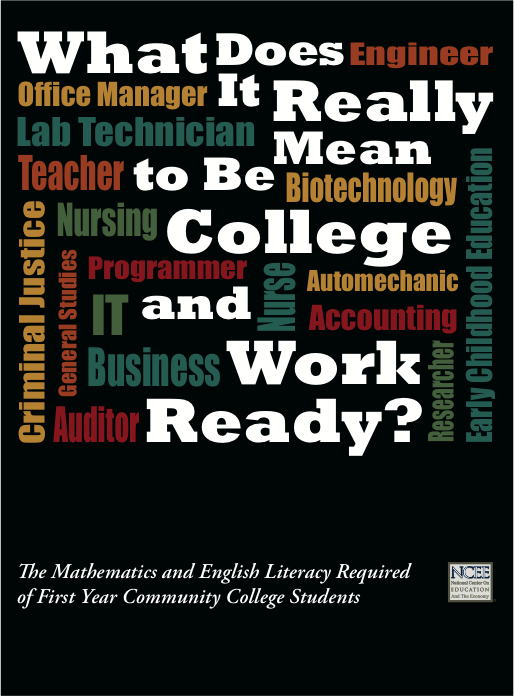
And what do all students need? In 2013, the National Center on Education and the Economy released a study What Does It Really Mean to Be College and Work Ready?, reporting on both mathematics and English literacy. The report says, "Mastery of Algebra II is widely thought to be a prerequisite for success in college and careers. Our research shows that that is not so... Based on our data, one cannot make the case that high school graduates must be proficient in Algebra II to be ready for college and careers."

California's Intersegmental Committee of the Academic Senates (ICAS) represents the faculty academic senates of the three CA systems of higher education: the University of California (UC), the California State University (CSU), and the California Community College (CCC) system. The ICAS Statement on Competencies in Mathematics Expected of Entering College Students, revised in 2013, describes a number of mathematical topics that are or could be taught in high schools.

The ICAS competency statement describes mathematical subject matter in four categories: Part 1: Essential areas of focus for all entering college students, Part 2: Desirable areas of focus for all entering college students, Part 3: Essential areas of focus for students in quantitative majors, and Part 4: Desirable areas of focus for students in quantitative majors.

The mathematics that the CCSSM describe as what all students need should presumably match with what the ICAS statement describes as "essential" and lists in Part 1. But although the UC Board of Admissions and Relations with Schools (BOARS) states there is "close alignment" between the CCSS and the ICAS statement, the ICAS statement makes clear that there are many CCSS that are not "essential" but rather merely desirable or for only some students. Appendix B of the ICAS statement explicitly shows where Part 2, 3, and 4 areas of math are found in the CCSS (and NCTM standards).

And the Interim Environmental Scan Report to The Common Assessment Initiative Steering Committee has in  Appendix B a Table that shows a number of CCSS that do not occur at all in the ICAS statement.

Here are examples of CCSSM topics that might surprise some community college math faculty, especially those who believe that intermediate algebra as currently taught will be sufficient to cover all the CCSSM.
  • Probability:  sample spaces, independent events, conditional probability, permutations and combinations; analyzing decisions and strategies using probability
  • Statistics: assessing the fit of a function by plotting and analyzing residuals; interpreting the correlation coefficient of a linear model in context; normal distributions, random samples, estimating population parameters, simulations, using probability to make decisions
  • Transformational geometry: congruence defined in terms of rigid motion; similarity defined in terms of dilations and rigid motions
  • Trigonometry: trig ratios, special angles, 6 trig functions of real numbers; modeling periodic phenomena, proof and use of the Pythagorean trig identity \( \cos^2 \theta + \sin^2 \theta = 1 \)

Tuesday, July 29, 2014

Schizophrenic Common Core Supporter


Back in 2012 Sol Garfunkel wrote "I feel like a schizophrenic. I truly think that the Common Core State Standards for Mathematics (CCSSM) are a disaster...So why do I feel like a schizophrenic? Because I am at the same time working to make the implementation of the CCSSM be as effective as possible!"

As mathematician Keith Devlin has emphasized, the heart of the CCSSM is the set of 8  standards of Mathematical Practice:

  • MP1. Make sense of problems and persevere in solving them.
  • MP2. Reason abstractly and quantitatively.
  • MP3. Construct viable arguments and critique the reasoning of others.
  • MP4. Model with mathematics.
  • MP5. Use appropriate tools strategically.
  • MP6. Attend to precision.
  • MP7. Look for and make use of structure.
  • MP8. Look for and express regularity in repeated reasoning.


It would be hard to imagine that any mathematician or math educator would not applaud these standards. And these standards, the key to the CCSSM and presented at the start of each set of grade level standards, are rarely if ever mentioned in the attacks on the CCSSM.

Much of the resistance to the CCSS is political: the Democratic President of the United States has endorsed the CCSS, so there is automatic opposition from the Tea Party, Republicans, and Libertarians, who argue that the CCSS is a federal program. But although President Obama is giving incentives for states to adopt the CCSS, the standards are the result of 48 state governors and secretaries of education agreeing to cooperate to create educational standards that would be consistent across state lines.

The resistance from the classroom teachers is understandable because they will be held accountable to how their students will do on the CCSS standardized testing. But the standardized testing that will be used is not part of the CCSS but rather is being created by SBAC or PARCC, consortia created to write CCSS assessments. That is, although the news media report teacher opposition to the CCSS, the teachers' actual objection is to the assessments and how they will be used.

The widely seen mocking and vilification of CCSS lessons by the public also confuse the CCSS with methods for testing students for mathematical proficiency. The CCSS explicitly require that students master the standard algorithms that critics mistakenly say are "real math" and missing from the CCSS. But significantly, the CCSS also require (MP1) that students can make sense of the mathematical tasks they are performing.

I think the CCSSM grossly overshoot the mark when trying to specify the math that all students need to be college and career ready. But like Sol Garfunkel, I think we should simultaneously embrace the CCSS and work to improve them.

Thursday, July 17, 2014

Math Initiatives for Student Success

The LearningWorks paper Changing Equations: How Community Colleges Are Re-thinking College Readiness in Math, written by Pamela Burdman, is a nice summary of current initiatives attempting to help capable students negotiate developmental math needs to succeed in transfer-level mathematics.

Much of the paper discusses the strategy of alternative pathways. In this strategy, students pass a course that is identical to, or has the same content and rigor of, accepted transfer math courses, but instead of first passing an intermediate algebra course, the students take a math course designed specifically to prepare them for the transfer course—that preparatory course omits some standard topics of intermediate algebra which are not necessary to succeed in the transfer math course.

The initial data on alternative pathways, some cited in Changing Equations, show that a much higher percentage of students initially placed in a developmental math course can pass a transfer level math course following an alternative pathway than by following the traditional chain of prerequisites. 

But both the University of California and the California State University systems require that intermediate algebra be a prerequisite for any transferable course. Keeping the intermediate algebra prerequisite based on the data that have shown success in intermediate algebra is a predictor of college success is, as pointed out in Changing Equations, following the error of confusing correlation with causation, and in fact the widespread practice of requiring success in intermediate algebra (a.k.a. Algebra 2) as a admissions requirement virtually guarantees the high correlation that has been often noted.

Friday, July 26, 2013

More on Alternative Pathways and transferability in California

California's adoption of the Common Core State Standards in Mathematics (CCSSM) helps to shape the expectations of universities regarding the mathematical background of their incoming students.

The July 2013 statement (http://senate.universityofcalifornia.edu/committees/boars/BOARSStatementonMathforAllStudentsJuly2013.pdf) from the University of California's Boards of Admissions & Relations with Schools (BOARS) comments that most California Community Colleges (CCCs) continue to use "traditional Intermediate Algebra (i.e., Intermediate Algebras as defined prior to CCSSM implementation)" as prerequisite to a transferable mathematics course.

The BOARS statement continues, "Specifying that transferable courses must have at least Intermediate Algebra as a prerequisite is not fully consistent with the use of the basic mathematics of the CCSSM as a measure of college readiness...Requiring that all prospective transfer students pass the current version of Intermediate Algebra would be asking more of them than UC will ask of students entering as freshmen who have completed CCSSM-aligned high school math courses. As such, BOARS expects that the Transferable Course Agreement Guidelines will be rewritten to clarify that the prerequisite mathematics for transferable courses should align with the college-ready content standards of the CCSSM."


Meanwhile, the Academic Senate of California Community Colleges (ASCCC) has endorsed the CCSSM, but has no formal position on alternative pathways.  A Fall 2012 resolution to support innovations to improve success in under-prepared non-STEM pathways was referred to the executive committee.  However, former ASCCC president Ian Walton did publish in the ASCCC Rostrum an opinion (http://asccc.org/content/alternatives-traditional-intermediate-algebra) that "The wide range of conversations demonstrates that a strong case can be made for the exploration and implementation of alternative preparations for transfer level math courses that differ from the content of the traditional intermediate algebra course."

Sunday, July 21, 2013

Alternative Pathways and transferability in California

California is home to the Carnegie Foundation for the Advancement of Teaching, the current force behind two pathway projects:  Statway and Quantway

An underlying assumption behind alternative pathways is that mathematics requirements for degrees and/or certificates should vary according to discipline. California's Student Success Task Force report contends, "Improved student support structures and better alignment of curriculum with student needs [Emphasis added] will increase success rates in transfer, basic skills, and career technical/workforce programs." The National Center on Education and the Economy 2013 report, "What Does It Really Mean to Be College and Work Ready?" states, "But our research...shows that students do not need to be proficient in most of the topics typically associated with Algebra II and much of Geometry to be successful in most programs offered by the community colleges."

The Carnegie Foundation, The Charles A. Dana Center at U.T. Austin, and the California Community College Success Network (3CSN) all promote alternative pathways to allow students in non-STEM disciplines an option of completing a university-transferable mathematics course without requiring the students to demonstrate completion of an intermediate algebra course.

The two California university systems, the University of California (UC) and the California State University (CSU) have been cautious in embracing the idea of alternative pathways in California Community Colleges (CCCs).

One pathway strategy is to provide students with an alternative  prerequisite to an existing transferable statistics class.  The alternative prerequisite does not have all traditional intermediate algebra topics and does not have elementary algebra as prerequisite. And in response to this strategy, Nancy Purcille of the UC Office of the President sent a March 7, 2013 email to CCC articulation officers:

"The prerequisite for UC-transferable math courses continues to be intermediate algebra or equivalent.  No attempt at this time will be made by UC to define specific content/courses that may be deemed “valid” alternate prerequisites.  When submitting a course for TCA review, if CCC faculty propose a prerequisite that they judge to be the equivalent of intermediate algebra, then UCOP articulation analysts will treat the prerequisite as such and evaluate the course outline as usual.  UC will not be evaluating the prerequisites listed – unless it is jointly requested by the CCC and UC faculty."

This position appears to respect the tenet that the community college should be able to decide the appropriate developmental math required to prepare its students for the articulated transfer-level math course.

The CSU provided a different position to accommodate alternative pathways.   Ken O'Donnell of the CSU Office of the Chancellor sent a November 2, 2012 email to CCC articulation officers that appeared to be discouraging alternative pathways:

"Please take this email as a reminder that only courses with a full prerequisite of intermediate algebra, as traditionally understood, will continue to qualify for CSU Area B4 [math/quantitative reasoning requirement to transfer].

"The CSU has made a recent exception for the Statway curriculum, under controlled and very limited circumstances, so we can evaluate whether other approaches will satisfactorily develop student proficiency in quantitative reasoning.  In the meantime, we count on the articulation community to uphold the current standard."

But Ken O'Donnell sent an April 2013 email acknowledging without objection the strategy of keeping the intermediate algebra the official prerequisite for the transfer math course but facilitating CCC student challenges to that prerequisite.


The CSU Chancellor’s General Education Advisory Committee has looked into this use of the prerequisite challenge process, and determined that it has no grounds to comment.  How community colleges meet curricular requirements that are below baccalaureate level is up to the colleges, and not up to the receiving transfer institutions.  In other words, community colleges may participate in initiatives like Acceleration in Context and the California Acceleration Project without jeopardizing articulation, because the transferable B4 course is unchanged; only the intermediate algebra prerequisite is challenged. 

Thus both the UC and the CSU are tacitly giving CCCs the go-ahead to develop alternative pathways.

Wednesday, January 16, 2013

Contradictory mandates to community colleges

A goal of the Common Core State Standards (CCSS) is to prepare students to be college and career ready.  That goal is also part of the mission of community colleges.  There has been considerable discussion regarding how  the CCSS might affect students' chances for getting into college, but scant discussion about how community colleges fit into the implementation of the CCSS.

Community Colleges might be assumed to have a distorted view of what it means to be college or career ready.  After all, they typically use the word "college" when naming themselves, yet eligibility to become a community college student does not require any minimum GPA nor any minimum score or ranking in any test.  It is sometimes said that the University of California serves the top 12.5% of California high school graduates, the California State University system the top 33.3%, and the California Community Colleges serve the top 100%.  But this is too limiting--a high school diploma is not a requirement for enrollment at any California Community College.

So at community colleges, we may worry less about "college ready" but rather focus on "transfer ready".  UCLA and CSUN are my school's two nearest public universities, and both report that our transfer students perform slightly better than their native students.  So there is evidence that community colleges are not grossly underestimating what is needed to be transfer ready.

California Community Colleges are presented with two conflicting mandates .   Community colleges  are encouraged 1) to align with K-12 standards for college and career readiness (according to the California Community College  Student Success Task Force  http://bit.ly/xOC5aK), and 2)  to provide alternative pathways to transfer (according to the Carnegie Foundation for the Advancement of Teaching  http://bit.ly/y1EZhX, the Charles A. Dana Center  http://www.utdanacenter.org/mathways/, etc.).

Explicitly, a consortium of the Charles A. Dana Center, Complete College America, Inc., Education Commission of the States, and Jobs for the Future, asks community colleges to provide a  "fundamentally new approach for ensuring that all students are ready for and can successfully complete college-level work that leads to a postsecondary credential of value.

"...The content in required gateway courses should align with a student’s academic program of study — particularly in math... Institutions need to focus on getting students into the right math and the right English." (from "Core Principles for Transforming Remedial Education: A Joint Statement" : http://bit.ly/TPqqCp)

The researcher at my institution estimated that 75% of our students interested in transfer are in disciplines that require no mathematics beyond an introductory statistics class to earn a baccalaureate degree at CSUN.  Evidently there are many students who can earn baccalaureate degrees without taking  single course from the mathematics department of any 4-year school.

The California Community College Success Network (3CSN.org), the Carnegie Foundation, the Dana Center, and the Student Success Task Force all recommend removing  curricular requirements  that act as barriers rather than aids to program completion.  The SSTF report contends, "Improved student support structures and better alignment of curriculum with student needs will increase success rates in transfer, basic skills, and career technical/workforce programs." [emphasis added]

The existing and proposed curricula of alternative pathways for non-STEM students omit many topics of intermediate algebra.

On the other hand, neither the University of California nor the California State University accepts a math or statistics course to meet  math transfer requirements unless that course has intermediate algebra as a prerequisite. 

If aligning with the CCSS implies that "intermediate algebra" should mean CCSS Algebra 2 (which includes circular trig and some inferential statistics), then the math requirements for transfer math courses will increase significantly.

And because intermediate algebra is the California Community College minimum math requirement for an associate's degree, the requirement for an AA degree will also increase simultaneously.

It is impossible for community colleges to remove unnecessary but currently required topics (for transfer to non-STEM disciplines) while simultaneously not merely maintaining but augmenting that list of required topics for all students.

Thursday, December 20, 2012

Alternative Pathways vs Common Core State Standards


A primary goal of the Common Core State Standards (CCSS) is to provide a curriculum to ensure that all high school graduates are college and career ready. The CCSS  math topics through grade 11 include not only all of the topics of the traditional U.S. Algebra 1-Geometry-Algebra 2 sequence, but also topics typically taught in courses named trigonometry and statistics.

Alternative pathways provide a means for non-STEM (i.e., non- Science, Technology, Engineering, and Math) students to transfer from a two-year college to a four-year institution and earn a bachelor's degree without needing to show mastery of traditional intermediate algebra topics. The promotion of alternative pathways challenges the premise that the CCSS for math are needed for all students to be college ready.

The common goal of both alternative pathways and the CCSS is to improve U.S. education.

 "Core Principles for Transforming Remedial Education: A Joint Statement" from the Charles A. Dana Center, Complete College America, Inc., Education Commission of the States, and Jobs for the Future, calls for revamping the two-year college remediation structure.  The paper lists seven Core Principals for a "fundamentally new approach for ensuring that all students are ready for and can successfully complete college-level work that leads to a postsecondary credential of value.

"...Principle 2. The content in required gateway courses should align with a student’s academic program of study — particularly in math.

"Gateway courses provide a foundation for a program of study, and students should expect that the skills they develop in gateway courses are relevant to their chosen program. On many campuses, remedial education is constructed as single curricular pathways into gateway math or English courses.

"The curricular pathways often include content that is not essential for students to be successful in their chosen program of study. Consequently, many students are tripped up in their pursuit of a credential while studying content that they do not need. Institutions need to focus on getting students into the right math and the right English.

"This issue is of particular concern in mathematics, which is generally considered the most significant barrier to college success for remedial education students. At many campuses, remedial math is geared toward student preparation for college algebra. However for many programs of study, college algebra should not be a required gateway course when a course in statistics or quantitative literacy would be more appropriate….

"...One final note: Postsecondary leaders must work closely with K–12, adult basic education, and other training systems to reduce the need for remediation before students enroll in their institutions.  Postsecondary institutions should leverage the Common Core State Standards by working with K–12 schools to improve the skills of their students before they graduate from high school. Early assessment of students in high school, using existing placement exams and eventually the Common Core college and career readiness assessments, which lead to customized academic skill development during the senior year, should be a priority for states. Similar strategies should be employed in adult basic education and English as a second language programs."

Monday, December 17, 2012

Common Core State Standards Algebra

One issue of concern for the California K-12 educators is that California currently requires students to pass Algebra 1 in order to earn a high school diploma. The Common Core State Standards (CCSS) version of Algebra 1 includes topics not traditionally associated with Algebra 1, for instance, exponential functions and some statistics.

Unless new legislation addresses this change in content, the adoption of the CCSS automatically raises the California high school graduation requirement.

A related issue more directly linked to California Community Colleges (CCCs) is that the CCSS has created a higher level Algebra 2. If community college intermediate algebra is to align with high school Algebra 2, then we will be raising our math requirement for the AA degree and for the prerequisite for transfer level math.

And the California Community College Student Success Task Force calls for better alignment:
"Aligning K-12 and community colleges standards for college and career readiness is a long-term goal that will require a significant investment of time and energy that the Task Force believes will pay off by streamlining student transition to college and reducing the academic deficiencies of entering students...

"Recommendation 1.1
"Community Colleges will collaborate with K-12 education to jointly develop new common standards for college and career readiness that are aligned with high school exit standards.

"The Task Force recommends that the community college system closely collaborate with the SBE and Superintendent of Public Instruction to define standards for college and career readiness as California implements the K-12 Common Core State Standards and engages with the national SMARTER Balanced Assessment Consortium to determine the appropriate means for measuring these standards. Doing so would reduce the number of students needing remediation, help ensure that students who graduate from high school meeting 12th grade-level standards are ready for college-level work, and encourage more students to achieve those standards by clearly defining college and career expectations."
I don't know who speaks for CCCs in the collaboration with the State Board of Education and Superintendent of Public Instruction.  But I do think it likely that one strategy to bring better alignment will be to use the Smarter Balanced assessments at grade 11 as placement instruments at the community colleges.  The other consortium creating CCSS assessments, PARCC, already has agreement among its adopting states to use its assessments for college placement.  (See, for example, http://bit.ly/QYVjUF.)


Thursday, November 22, 2012

Alternative pathways


It seems that student-success discussion at two-year colleges is shifting from "course redesign" to "alternative pathways" for the math required to transfer.

The topics overlap considerably, because the idea of alternative pathways normally involves modifying course prerequisites in format and/or content.

Some community colleges are exploring alternative pathways via multiple versions of intermediate algebra.  For example, several campuses have a "pre-stats" course which prepares students for the regular statistics course, but the pre-stats course does not cover all of intermediate algebra (and may not have elementary algebra as a prerequisite). 

The Carnegie Foundation for the Advancement of Teaching, the Dana Center at UT Austin, and 3CSN (California Community College Success Network) are three groups promoting the development of alternative pathways through dev math for non-STEM majors. The California State University system has agreed to accept Statway™ (Carnegie's two-semester course beginning at the elementary algebra level and ending with a transferable statistics credits) for meeting the Area B4 (math/quantitative  reasoning ) requirement for transfer.

But  last month the CSU emailed California Community College articulation officers the following:

"When the CSU reviews community college courses proposed to satisfy Area B4, we look for a prerequisite of intermediate algebra. We’re aware that many community colleges are experimenting with alternative prerequisites to their approved B4 courses, in an effort to improve student persistence. Some of these alternatives take away topics traditionally included in intermediate algebra; others substitute a different course altogether.

 "Please take this email as a reminder that only courses with a full prerequisite of intermediate algebra, as traditionally understood, will continue to qualify for CSU Area B4.

 "The CSU has made a recent exception for the Statway™ curriculum, under controlled and very limited circumstances, so we can evaluate whether other approaches will satisfactorily develop student proficiency in quantitative reasoning. In the meantime, we count on the articulation community to uphold the current standard."

That email seems to cast doubt on the future of alternative pathways.  But in the meanwhile, the CSU appears to be fine with the strategy proposed by Palomar College.  Palomar is not changing the intermediate algebra prerequisite for statistics, but evidently students who pass the alternative pre-stats course will be allowed to waive the intermediate algebra prerequisite.

Friday, October 12, 2012

Supporting community college faculty across the disciplines


I recently spent 48 hours in Northfield, MN (home of Malt-O-Meal) to work with educators from different disciplines and different organizations trying to find ways to increase two-year college faculty awareness of and participation in professional development opportunities.

The workshop was hosted by Carleton College and its Science Education Research Council.  SERC (http://serc.careltoncollege.edu) has amassed an impressive collection of resources across multiple disciplines including geoscience (the first discipline), chemistry, economics, mathematics, physics, psychology,  and more. 


The Pedagogy in Action page (http://serc.carleton.edu/sp/) has links for Teaching Methods, Activities, and Research on Learning. SERC is continually seeking to improve its website to become a one-stop launching point for finding discipline-specific lesson plans, research-based pedagogical strategies, student projects, career information--essentially anything of interest to an educator seeking to improve student learning.

SERC has also been learning how to run effective workshops.  We were given pre-workshop assignments to upload essays into designated spaces on the SERC website that were visible to the other  participants but not to the rest of the world.  And during  the workshop we were constantly moving from whole group to small group activities, mixing tasks from cross-discipline to the discipline-specific. 

Each group would choose a recorder, who wirelessly entered directly into the SERC system.  The others in the small working group could see the notes on their own computers during their discussion, and the notes were available to the whole group during the "share out" session. Working across disciplines allowed us to learn of challenges and strategies that gave us fresh perspectives for our discipline-specific discussions.

The real-time recording of discussions means that our notes won't be accidentally lost among papers or luggage during our journeys home. Eventually the notes from our workshop will be organized, polished, and made publicly accessible on the SERC site.

Tuesday, August 7, 2012

CCSS and Community College Math Programs


We may need a complete redesign of the developmental math program in US two-year colleges.

My campus currently uses a placement test (Mathematics Diagnostic Test Project) to determine if students are ready for transfer level courses (math for elementary school teachers, stats, trig, precalculus, calculus)  or what remedial course (arithmetic, prealgebra, elementary algebra, intermediate algebra) they should take.

But the Common Core State Standards for mathematics will have high school students studying mathematics organized in a fashion that does not align with our existing math courses.

California is one of the 45 states that have formally adopted the CCSS for mathematics, and I am on a recently appointed state committee whose charge is to align California’s math standards (a.k.a. the California Framework) with the CCSS.

One of the main reasons that I applied to be on the Mathematics Curriculum Framework and Evaluation Criteria Committee (MCFCC) was to better familiarize myself with what is to be taught in California's K-12 schools.  (Another reason was to lose myself in abbreviations:  SBE for State Board of Education, CDE for California Department of Education, IQC for Instructional Quality Commission, the body that forwarded my name to the SBE for approval to serve on the MFCC to align the CF with the CCSS.)

The CCSS specify a consensus of what math is required for students to be college or career ready.  The standards are grouped into six conceptual categories:  Number and Quantity, Algebra, Functions, Modeling, Geometry, and Statistics and Probability.  (There are separately eight standards for mathematical practice that go across all grade levels.)

The CCSS differ significantly from what is typically required for graduation in most American high schools today.  For example, the treatment of statistics and probability includes not only descriptive statistics but also conditional probability, inference, decisions based on probability, and rules of  probability. 

The CCSS include not only right-triangle trigonometry but also trig functions of a real variable, to be used in modeling periodic behavior.  Thus trig spans the geometry, algebra, and function categories.

The CCSS gives math standards for high school without specifying courses or order of topics.  But evidently the introduction of functions includes an emphasis on (linear and) exponential functions with domains restricted to a subset of the integers--sequences are explicitly studied as functions.

California community colleges do not require a high school diploma for admission.  A student who masters the first CCSS high school math course will already have compared exponential functions with linear functions and solved equations both algebraically and graphically. The student will have had explicit instruction on descriptive statistics.  The student may have worked with constructions and transformations in the plane and proved simple geometric theorems algebraically but not yet worked with polynomials (and specifically not with quadratic functions or quadratic equations).

How will our placement system advise this student?

One of the recommendations  of California's Student SuccessTask Force is for better alignment between high school and college curricula.  With the CCSS adopted across states, it looks as if most community colleges will need to make adjustments to their way of placing and educating their math students.

Saturday, April 28, 2012

Math Pathways: Designing for Success


On Friday April 27, 2012, Los Angeles Pierce College hosted a conference to share ideas about curricular and institutional redesign efforts for mathematics at two-year colleges.  A central theme was to improve the rate that  students are able to achieve degrees, certificates, and transfers to four-year institutions--essentially the "to and through" goal embraced by the Statway and Quantway projects of the Carnegie Foundation for the Advancement of Teaching and by the New Mathways projects of the Charles A. Dana Center.

A substantial majority of community college students who take a placement exam place into remedial education courses.  And perhaps only one in five of those who place in remedial math ever succeed in passing a college level math course.

Julie Phelps of Valencia Community College FL was the keynote speaker. She provided a national perspective on the the scope of the problem of students languishing in developmental math classes and discussed some of the initiatives throughout the U.S. that are trying to address the issue.

The break-out sessions at the conference were grouped into three themes:  Before Algebra, STEM Pathways, and Non-STEM Pathways.  At each break-out, math faculty panelists from local community colleges (Pasadena City College, College of the Canyons, and Pierce) discussed strategies being implemented at their campuses.

The conference was sponsored by the California Community Colleges Success Network (3CSN) under the leadership of Deborah Harrington and organized by dean Crystal Kiekel of Pierce College. The 3CSN.org website will host slideshows for not only the keynote presentation from Julie Phelps, but also from the break-out presenters Linda Hintzman, Charlie Hogue, and Roger Yang  of Pasadena City College; Kathy Kubo and Matt Teachout of College of the Canyons; Bob Martinez, Jenni Martinez, Ben Smith, Kathie Yoder, and Kathy Yoshiwara of Los Angeles Pierce College.

Sunday, April 24, 2011

Statway Research About Teaching and Learning


Statway Institute - Jim Stigler - Winter 2011 from Statway on Vimeo.

Statway is one project of the Carnegie Foundation for the Advancement of Teaching seeking to find alternative math pathways to baccalaureate degrees.  There are so many interesting pieces going into Statway that the project promises to provide useful information even to educators who are appalled at the idea of allowing a non-STEM major to earn a BA without passing an intermediate algebra class.

Carnegie posts Statway resources on their site.  Here are a few I find particularly interesting.

  • David Yeager's video discusses productive persistence in students.  This was probably the most talked about presentation at the 2011 Statway mid-year institute.  Skip to 7:00 into the video for data on improved success for community college students (+17 percentage points) by introducing self-regulated learning.  Skip to 10:15 for discussion of Carol Dweck's work on mindsets, or skip to 18:40 for improvement resulting from a single 45-minute psychological intervention (+.3 gpa).  Go to 21:00 for a discussion of stereotype threat, with data on student impact (-39% memory span; -13% on a math test at 24:10) because of the threat, or go to 25:15 to learn how the stereotype threat can be eliminated with two 15-minute interventions. 
  • Jim Stigler's video (above) describes teaching as a cultural activity.  Stigler outlines some of the challenges US educators face to adopt effective practices that are the norm in other countries.  (Hint:  In the typical classroom of the countries that are top-ranked because of high student performance in math and science, the students are expected to struggle with problems that they have not been shown how to solve, and the instructors allow the students to be frustrated for much longer than American teachers could tolerate.) 
  • Jim Stigler, Karen Givven, and Belinda Thompson (all of UCLA) reported to Carnegie on "What Community College Developmental Mathematics Students Understand about Mathematics."  (The report was later the basis of an article of the same title in the MathAMATYC Educator.)

Friday, August 28, 2009

Tales of student cheating

At Simon Fraser University in Burnaby, B.C., there is now a grade of FD, considered lower than F, for a students found guilty of egregious cases of academic dishonesty. (http://www.calgaryherald.com/university+adds+grade+worse+than/1890672/story.html)


In contrast, at California community colleges, "...it is not permissible to give a student either a failing grade or an incomplete because a student has cheated on a particular assignment" no matter how egregious the offense (http://www.cccco.edu/Portals/4/Legal/opinions/attachments/07-12.pdf ).


Here are two tales from my campus in the 2008-2009 academic year. In the first, a student paid a ringer $1000 (yes, one thousand US dollars) to sit next to him during a calculus exam, and also paid $100 to each of several other students in class just to sit in seats surrounding the two principals. When the ringer completed the exam (early), a pre-planted cellphone went off. It took the instructor some time to locate the cellphone, which was stashed in a trash can. While the instructor was thus distracted, the ringer handed off his completed exam to the cheater, who then copied answers in his own handwriting . The ringer was not enrolled in the course (someone dropped from the class that day) and simply did not turn in an exam. We learned of the scheme because one of the $100 classmates confessed.


In the second case, an online student paid $100 for a ringer to take an elementary algebra quiz. We learned this from the ringer, who forwarded to the math department chair an email from the cheater detailing the instructions for taking the quiz and proposed payment--the ringer was outraged because the cheater "was suppossed [sic] to pay me $100 for the same which he didnt [sic]."


In neither case could the instructor assign a grade of F. The calculus student passed and the algebra student dropped the course.


And by the way, unless your school is so small that the instructors know all the students on campus, you probably have students on your campus taking classes for others.


Here's how the scam works.


Abe and Bob both sign up for English 1 and Math B, but different sections of each subject. Abe attends and does the work for both English classes and Bob does the same for both math classes. The four instructors involved know the names and faces of all the students in their classes, so they never bother to check IDs. (Professor Yee doesn't know that Abe attends her English class every day answering to the name of Bob, and Professor Zed doesn't know that Bob attends her Math class every day answering to Abe).


The two cheaters get credit for two classes while only needing to master the material for one (and without having to pay any bribe money).


A few years ago we actually had a case of a man taking a class for a woman. Classmates were upset that the ringer was raising the curve, and they informed the instructor that the same person was answering to an entirely different name in other classes. The student who was actually enrolled in the class was Asian, and her instructor did not recognize that her name was a woman's. The only consequences to the students were that they had to speak with a vice-president, and that neither got credit for the class that semester.

Sunday, August 23, 2009

Section 508 and the Use of Non-captioned Videos

The ADA compliance officer on my campus says that I am forbidden to provide a link to any of the wonderfully useful videos I find on YouTube or MathTV because of Section 508 of the Rehabilitation Act.


The text of Section 508 can be found at http://www.access-board.gov/sec508/guide/act.htm, and FAQs can be found at http://www.access-board.gov/sec508/faq.htm. The main idea of the statute was to require that information technology resources purchased with public funds be accessible to people with disabilities. And, from the FAQ page cited above, “In general, an information technology system is accessible to people with disabilities if it can be used in a variety of ways that do not depend on a single sense or ability.”


But the subsequent state adoption of the regulation has altered the thrust of the regulation. The popular interpretation is that the regulation forbids the use of any video that is not captioned.


I recognize that captioned videos can be beneficial to many students, not only those with disabilities. And I do plan to include captioning when I create videos. But it is ridiculous that I cannot recommend existing excellent math videos (which are useful even without sound) to my face-to-face classes, not even as an optional resource for which no credit is awarded.


My issue is not about the benefits of having captioned videos, it's about a wrong-headed policy that exceeds the actual statute requirements and forbids using valuable resources.


The mucky-mucks embrace the ban on all non-captioned videos because they want to minimize any chance of a lawsuit of any sort. But they do not consider that the easiest path for an instructor is to avoid making any use of the Web, and the result will be that the students will actually have their learning experience diminished.


I'm trying to find some credible person who can explain what adoption of the statute actually requires. But so far I've only found people who can tell me the policy that their school/district/system has adopted, not anyone who has familiarity with the actual statute.