Legislators, school administrators, and other policy makers have encouraged and/or mandated the use of open source textbooks to ease the financial burden on students. An obvious counter-argument is that you get what you pay for.
There is no doubt that major publishing companies provide more faculty-pleasing bells and whistles than are found with open source textbooks. On the other hand, many students do not obtain their textbooks until after classes begin, often going days or weeks without required materials. The benefits of the commercial textbook diminish or disappear entirely for students who do not have their textbooks, and this problem is exacerbated when students take more classes on-line and visit the campus bookstore less often.
Meanwhile, the faculty involved with the PreTeXt project (https://pretextbook.org/) are working to create textbooks superior to commercial textbooks.
The first obvious advantage is that the instructor can provide a link to the html version of the textbook before class begins. Next, unlike a pdf with fixed line breaks that may force the reader to scroll left and right, the html version is designed to be readable not only on computer screens but also on the small displays of mobile devices.
The PreTeXt project is a partner with the American Institute of Mathematics (https://aimath.org/) in the NSF-funded UTMOST Project (https://utmost.aimath.org/), seeking “to understand how students and faculty actually use textbooks in undergraduate mathematics courses and to use that understanding to produce textbooks that are more effective in promoting student learning.”
Two relatively mature textbooks authored in PreTeXt are Active Calculus (Matt Boelkins) and ORCCA (Open Resources for Community College Algebra, Ann Cary, Alex Jordan et al.). Both have associated videos corresponding to each lesson, and both have homework sets coded in the open source WeBWorK online homework system. (For schools that cannot host the free WeBWorK system themselves, there are options such as xyzhomework and Edfinity that offer low-cost alternatives to the publisher sponsored homework systems.)
Some of the textbooks written in PreTeXt provide embedded interactive exercises that the student answers in the book and gets immediate feedback. And via a collaboration with Runestone Academy (https://runestone.academy/), it is even possible to set up a course so that Runestone Academy will record the responses students make in the textbook without requiring the student to log into a homework system.
One talking point about open source textbooks is that faculty have the option of taking the parts they like, changing parts they dislike, and/or adding components they feel are missing, then publish their own versions. That does not happen very frequently in practice, but interested users can work with the textbook authors to create ancillaries to share with the community.
Thursday, July 23, 2020


Thursday, March 29, 2018
Switching to Linux
I’ve recently switched from Windows to Linux.
The main impetus was that I’m trying to help Katherine Yoshiwara (my wife) code her math textbooks into PreTeXt (http://mathbook.pugetsound.edu/), and the key players creating PreTeXt all say things like “I’m not familiar with how to do this in Windows, but it’s simple in Linux.”
I set up my current (Christmas gift) pc to dual boot Ubuntu Mint and Windows10. I first practiced on my previous (and dying) pc, and I was unwilling to abandon Windows entirely.
A turning point was last week when I got onedrive-d running, so now I can have my Microsoft OneDrive directory files synced and available when in Linux.
I’d already discovered that I can create, read, and edit MS Office files using LibreOffice (provided with Linux), Google Docs, and with Chrome plug-ins, so I have no worries about collaborating with others that use MS Office formats.
Then two days ago my laptop refused to reboot in Linux.The machine hung up at the same spot with a message I could not understand (about performing fsck manually) even when I tried selecting earlier versions of Linux at startup. I could still boot in Windows, but I now think that was one mistake that led to a bigger one: I okayed an update to Dropbox, and when the update was complete, Windows had killed “grub” and Linux was nowhere to be found on my computer.
But using my still-working old laptop, I managed to find online how to restore grub, then how to perform the manual fsck (I managed to follow steps, but I still have no idea what I was actually doing). And then I still had to repair a github directory (the corruption of which had led me to try a reboot in the first place).
But I think I’m back in business. And I'm even more convinced that Linux is the way to go.
Tuesday, March 20, 2018
PreTeXt: A Promising Tool for Open Source Textbooks
Although I have been (and remain) largely unimpressed with the quality of the great majority existing open source math textbooks, I now believe there is hope on the horizon.
The model used by open software developers, namely of modifying existing materials and improving them, can apply to math textbooks. Rob Beezer’s PreTeXt tool gives authors a means of producing digital textbooks that are superior to existing popular commercial textbooks.
With PreTeXt you can convert a (properly marked up) plain text file into html format that is optimized for reading on mobile devices. It uses MathJax for the mathematical expressions, and the developers are designing to take advantage of open software like the Sage cell for interactivity and WeBWorK or MyOpenMath for homework checkers.
Another cool feature is that PreTeXt can take the same source text file and output LaTeX and hence pdf, for students who may want a printed version of the textbook.
The readability on mobile devices, the adaptability of the source files, the tools for interactivity, and the attention the developers pay to accessibility issues are huge benefits to adopting PreTeXt books (which, by the way, are not limited to math—PreTeXt has also been used in computer science, poetry, and music textbooks).
Saturday, December 3, 2016
Learning Styles and Optimizing Learning
"Learning Styles: Concepts and evidence," Psychological Science in the Public Interest, V. 9 No 3, December 2008, by Harold Pashler, Mark McDaniel, Doug Rohrer, and Robert Bjork examined whether or not there was scientific evidence to support the "learning-styles" practice of matching the format of instruction to the learning style of the individual learner.
They authors described what evidence would be appropriate to validate the learning-styles practice. For distinct learning styles A and B, learners with learning style A should learn better with an instruction/intervention with learning style format A than with instruction/intervention with learning style format B, and vice versa: learners with learning style B should learn better with instruction/intervention of format B than format A.
The authors were actually more generous in what they considered acceptable evidence. But simply finding that learners A did better with intervention A than with intervention B was not sufficient--it was also necessary to show that learners B did worse with intervention A than with B.
And at that time (December 2008) the authors found no evidence base to justify incorporating learning-style practices. And in 2016, there still has been no adequate evidence to justify the use of learning-styles practices.
Among professionals who research learning, there is consensus that it is not effective to teach towards the learning style of the individual student. Yet across the K-16 spectrum there are ardent adherents to the learning-styles practice.
From the opening of Philip M. Newton's "The Learning Styles Myth is Thriving in Higher Education," Frontiers in Psychology, 15 December 2015, "The existence of ‘Learning Styles’ is a common ‘neuromyth’, and their use in all forms of education has been thoroughly and repeatedly discredited in the research literature. However, anecdotal evidence suggests that their use remains widespread."
Both Newton and Pashler et al. acknowledge that people can readily identify with a preferred learning style and that there is validity to the identification. But there still is no evidence that learning is enhanced by identifying a student's learning style and providing instruction geared towards that style.
The promotion of the learning-styles practices is not an innocuous indulgence. Not only does the emphasis on learning styles take time and resources away from proven effective interventions, the emphasis on learning styles can potentially reinforce a fixed mindset and steer students away from certain leaning challenges and academic paths.
Tuesday, June 7, 2016
"Unjustified use of Algebra 2"
The U.S. Department of Education organized a meeting (“California Math Convening: Gateways to Access – May 31, 2016”) to discuss California's use of Algebra 2 (a.k.a. Intermediate Algebra) in higher education. The meeting was held at the chancellor's office of the California State University (CSU) system. The participants included representatives from the CSU, the University of California, the California Community Colleges, K-12 educators, and educational policy organizations.
The meeting was the DOE's response to a September 30, 2015 letter from Christopher Edley, Jr., to the Catherine Lhamon, Assistant Secretary of Civil Rights, U.S. Department of Education. The letter begins with:
Another speaker was William McCallum, mathematician with numerous distinctions including being one of the three lead writers of the Common Core State Standards in Mathematics (CCSSM). Bill explained that because College Algebra was the de facto mathematics requirement in U.S. baccalaureate granting institutions at the time of writing the CCSSM, the document needed to include the math that would lead to College Algebra, namely Algebra 2. He commented that it is inappropriate for colleges or universities to cite the CCSSM to define what is currently needed to be college ready--it makes no sense to argue against modifying college math requirements based on the content of the CCSSM, as the CCSSM were created trying to reflect what the earlier college math requirements had been.
The U.S. DOE evidently intends to hold another such meeting in 3 or 4 months to check on what progress has been made.
The meeting was the DOE's response to a September 30, 2015 letter from Christopher Edley, Jr., to the Catherine Lhamon, Assistant Secretary of Civil Rights, U.S. Department of Education. The letter begins with:
“I write to request that your office investigate the educationally unjustified use of Algebra 2 as a gateway course by all three segments of California’s higher education system: the University of California system; the California State University system; and the California Community College system. There is evidence to suggest that, in varying ways, these institutions have adopted policies and practices that impose a disparate impact on protected groups in violation not only of the equal protection clause of the California State Constitution, but also in violation of federal regulations implementing Title VI of the Civil Rights Act of 1964.”The letter cites the success of Statway, a project of the Carnegie Foundation for the Advancement of Teaching, as evidence that Intermediate Algebra is not actually necessary for success in completing math requirements for baccalaureate degrees in some majors. The letter concludes with:
“If there are villains here, they are the indifference and inertia that confirm and perpetuate unequal educational opportunity. I believe this discrimination is, for the most part, without animus. Regardless, the injury is real.”At the meeting, Christopher Edley Jr. explained that neither intent nor a history of practice would be considered relevant when determining if there is a violation of the Civil Rights Act. The presence of both Catherine Lhamon and also the Under Secretary U.S. DOE, Ted Mitchell, made abundantly evident that the DOE wants California's higher education community to recognize and address the issue.
Another speaker was William McCallum, mathematician with numerous distinctions including being one of the three lead writers of the Common Core State Standards in Mathematics (CCSSM). Bill explained that because College Algebra was the de facto mathematics requirement in U.S. baccalaureate granting institutions at the time of writing the CCSSM, the document needed to include the math that would lead to College Algebra, namely Algebra 2. He commented that it is inappropriate for colleges or universities to cite the CCSSM to define what is currently needed to be college ready--it makes no sense to argue against modifying college math requirements based on the content of the CCSSM, as the CCSSM were created trying to reflect what the earlier college math requirements had been.
The U.S. DOE evidently intends to hold another such meeting in 3 or 4 months to check on what progress has been made.
Saturday, February 7, 2015
Strategies to help developmental math students
Nationally about 70% of incoming community college students are placed into developmental (a.k.a. “remedial” or “foundational”) math classes that earn no college degree credit. But only 10% of these students successfully move past developmental math to earn their degrees.
Four broad areas are being addressed to increase student success through developmental mathematics (1) Placement, (2) Pedagogy, (3) Curriculum, and (4) Student attitudes.
Improving Placement
Failing a class is not the only barrier to completion--the length of the developmental math path defeats many students. More developmental math students drop out of college without ever failing a math class than flunk out of math. One strategy to reduce the number of “exit points” is to help students place into as high a math level as reasonable.
For example, Cañada College uses its Math Jam both as an intensive preparation for the math placement exam and also as a recruitment tool to get more students into STEM fields.
The placement instrument itself, typically a machine-graded standardized test, can be augmented or replaced. High school GPA, recency of the previous math course, weekly work hours, and total course load could be part of “multiple measures.” Some schools have abandoned placement into developmental math courses, typically offering supplementary resources for students in credit-bearing classes.
Modifying Pedagogy
James Stigler lists three key types of learning opportunities that students need to experience to become flexible learners: productive struggle, explicit connections, and deliberate practice.
Modularized courses can allow students to spend time only on topics they need to study. The Emporium Model relies on software to do the pretest, primary instruction, and mastery testing, with human interaction largely limited to one-on-one tutoring in the computer lab (where students work lessons and take assessments). The University of Illinois uses software for placement and remediation, and California State University Northridge uses software as part of its hybrid lab remediation for students considered “at risk.”
Technology also plays a key role in both MOOCs (Massive Open Online Courses) and the “flipped” classroom. However, the “MO” aspects of MOOCs appear not to improve student success compared with the online developmental math courses that have existed for decades.
Another way to address the attrition between courses in a sequence is to offer “compressed” courses. The students take two courses during one term, but each course meets the standard number of hours per term--students are essentially immersed in math, which comprises most or all of their studies for that term.
Adjusting the Curriculum
The American Mathematical Association of Two-Year Colleges (AMATYC) has a 2014 position paper that states, “Prerequisite courses other than intermediate algebra can adequately prepare students for courses of study that do not lead to calculus.”
There are numerous “pathways” that have been created to allow developmental math students to pass a transferable math course--typically statistics or a quantitative reasoning course--that do not require many topics typically associated with intermediate algebra. The pathways normally reduce the number of developmental math courses required before earning transferable math units.
- Path2Stats is part of the California Acceleration Project, based on a program developed by Myra Snell at Los Medanos College.
- Statway and Quantway are projects of the Carnegie Foundation for the Advancement of Teaching.
- The Dana Center’s Math Pathways include pathways for both STEM and non-STEM students.
- Mathematical Literacy for College Students (MLCS) and Algebraic Literacy grew out of an AMATYC project. They can serve as alternatives to beginning and intermediate algebra classes for STEM majors, or the MLCS can serve as prerequisite for a transferable non-STEM math course.
Addressing student attitudes
The “affective domain” includes attitudes, values, beliefs, interests, and motivation.
Carol Dweck’s research indicated that students (from grade school through graduate school) with “growth mindsets” persist and succeed better than peers with “fixed mindsets”. And importantly, students can learn to move from a fixed mindset to a growth mindset.
David Yeager’s research suggests that the performance gap in math--specifically developmental math--suffered by women and other underrepresented groups can be eliminated by specific brief interventions.
City University of New York's Accelerated Study in Associate Programs (ASAP) is an initiative that does not attempt to modify what occurs in the classroom. ASAP stipulates full-time enrollment and provides participants with academic advisement, career services, tutoring, financial supports, specially blocked or linked courses.
Sunday, December 28, 2014
Perfect numbers
"'I'll show you one more thing about perfect numbers," he said..."You can express them as the sum of consecutive natural numbers." Yoko Ogawa, The Housekeeper and the Professor, translated by Stephen Snyder
The examples that immediately follow the statement in the novel show that the perfect numbers 6, 28, and 496 are triangular numbers, that is, can be expressed as a sum of the form \(1+2+3+\cdots+n\).
This got me thinking about perfect numbers. For example,
Theorem: The reciprocals of the divisors of any perfect number sum to 2.
Proof: If the divisors of the perfect number \(N\) are \(1, d_2, d_3, \ldots, d_k\), and \(N\), then the sum of the reciprocals would be
\(1/1 + 1/d_2+ 1/d_3 \cdots + 1/d_k+ 1/N\). If we call this finite sum \(s\), then
\[Ns=N/1 + N/d_2+ N/d_3 \cdots + N/d_k+ N/N\]
\[ = N + d_k +\cdots +d_3+ d_2 + 1\]
\[= N +(\text{proper divisors of N}) = N+N = 2N\] Thus \( s=2\)
Theorem: Every even perfect number has the form \(N=(2^k -1)\cdot 2^{k-1}\), where \(2^k - 1\) is a Mersenne prime.
Proof: Let \(N\) be an even perfect number. Then \(N\) can be written in the form \(N=2^{k-1} m\), where \(k>1 \)and \(m\) is odd.
Define \(\sigma(n)\) to be the sum of all positive divisors of \(n\). In particular, \(\sigma(n)=2n\) whenever \(n\) is perfect.
When \(a\) and \(b\) are relatively prime, \(\sigma(ab)=\sigma(a)\sigma(b)\) because every divisor of \(ab\) can be uniquely written as the product of a divisor of \(a\) times a divisor of \(b\), so summing the divisors of \(ab\) can be accomplished by first computing \(\sigma(a)\) and multiplying it by each of the divisors of \(b\), and summing those products.
Solving for \(\sigma(m)\), we get \(\sigma(m)=m+ \frac{m}{2^k-1} \)
From the definition of \(\sigma(m)\), \(m+ \frac{m}{2^k-1} \) must represent the sum of all divisors of \(m\), and in particular the fraction must be an integer. But then \(\frac{m}{2^k-1}\) must itself divide \(m\), and as \(m\) clearly divides itself, \(m\) and \(\frac{m}{2^k-1} \) must be all the divisors of \(m\). Thus \(m=2^k-1\) must be prime.
Conversely, Theorem: Each Mersenne prime \(2^k -1\) gives the perfect number \(N=(2^k -1)\cdot 2^{k-1}\).
Proof: If \(2^k - 1\) is prime, then the divisors of \(N=(2^k -1)\cdot 2^{k-1}\) are \(1, 2, 2^2, \ldots, 2^{k-1},\) and also the product of any of those powers with the prime \(2^k - 1\). Summing all the proper divisors is the sum of two geometric series, each with common ratio 2. We get
\[\left(1+2+…+2^{k-1}\right) + \left(2^{k}-1\right) \left(1+2+…+2^{k-2}\right)\]
\[ = \left(2^k -1\right) + \left(2^{k}-1\right) \left(2^{k-1}-1\right)\]
\[= \left(2^k -1\right) \left(1+ 2^{k-1}-1\right) = N\]
We can see that every even perfect number is a triangular number, because \(N=(2^k -1)\cdot2^{k-1}\) has the form \(\frac{(n-1)n}{2}\), where \( n = 2^k\).
Euler evidently knew everything about even perfect numbers, but as far as I know, neither he nor anyone else has proven whether or not any odd perfect number exists.
I don't know whether an odd perfect number would need to be a triangular number. But the Professor only asserted that perfect numbers can be expressed as a sum of consecutive natural numbers. And of course any odd number \(O = 2n+1\) --including any odd perfect number-- can be expressed as the sum of two consecutive natural numbers: \(n + (n+1)\).
The examples that immediately follow the statement in the novel show that the perfect numbers 6, 28, and 496 are triangular numbers, that is, can be expressed as a sum of the form \(1+2+3+\cdots+n\).
This got me thinking about perfect numbers. For example,
Theorem: The reciprocals of the divisors of any perfect number sum to 2.
Proof: If the divisors of the perfect number \(N\) are \(1, d_2, d_3, \ldots, d_k\), and \(N\), then the sum of the reciprocals would be
\(1/1 + 1/d_2+ 1/d_3 \cdots + 1/d_k+ 1/N\). If we call this finite sum \(s\), then
\[Ns=N/1 + N/d_2+ N/d_3 \cdots + N/d_k+ N/N\]
\[ = N + d_k +\cdots +d_3+ d_2 + 1\]
\[= N +(\text{proper divisors of N}) = N+N = 2N\] Thus \( s=2\)
Theorem: Every even perfect number has the form \(N=(2^k -1)\cdot 2^{k-1}\), where \(2^k - 1\) is a Mersenne prime.
Proof: Let \(N\) be an even perfect number. Then \(N\) can be written in the form \(N=2^{k-1} m\), where \(k>1 \)and \(m\) is odd.
Define \(\sigma(n)\) to be the sum of all positive divisors of \(n\). In particular, \(\sigma(n)=2n\) whenever \(n\) is perfect.
When \(a\) and \(b\) are relatively prime, \(\sigma(ab)=\sigma(a)\sigma(b)\) because every divisor of \(ab\) can be uniquely written as the product of a divisor of \(a\) times a divisor of \(b\), so summing the divisors of \(ab\) can be accomplished by first computing \(\sigma(a)\) and multiplying it by each of the divisors of \(b\), and summing those products.
Now \(\sigma(N)=2N=2^k m\) because \(N\) is perfect. By adding a finite geometric series with common ratio 2, we see that \(\sigma(2^{k-1})=2^k-1\), and we have
\(2^k m= \sigma(2^{k-1}m) = \sigma(2^{k-1})\sigma(m)=(2^k-1)\sigma(m)\)
Solving for \(\sigma(m)\), we get \(\sigma(m)=m+ \frac{m}{2^k-1} \)
From the definition of \(\sigma(m)\), \(m+ \frac{m}{2^k-1} \) must represent the sum of all divisors of \(m\), and in particular the fraction must be an integer. But then \(\frac{m}{2^k-1}\) must itself divide \(m\), and as \(m\) clearly divides itself, \(m\) and \(\frac{m}{2^k-1} \) must be all the divisors of \(m\). Thus \(m=2^k-1\) must be prime.
Conversely, Theorem: Each Mersenne prime \(2^k -1\) gives the perfect number \(N=(2^k -1)\cdot 2^{k-1}\).
Proof: If \(2^k - 1\) is prime, then the divisors of \(N=(2^k -1)\cdot 2^{k-1}\) are \(1, 2, 2^2, \ldots, 2^{k-1},\) and also the product of any of those powers with the prime \(2^k - 1\). Summing all the proper divisors is the sum of two geometric series, each with common ratio 2. We get
\[\left(1+2+…+2^{k-1}\right) + \left(2^{k}-1\right) \left(1+2+…+2^{k-2}\right)\]
\[ = \left(2^k -1\right) + \left(2^{k}-1\right) \left(2^{k-1}-1\right)\]
\[= \left(2^k -1\right) \left(1+ 2^{k-1}-1\right) = N\]
We can see that every even perfect number is a triangular number, because \(N=(2^k -1)\cdot2^{k-1}\) has the form \(\frac{(n-1)n}{2}\), where \( n = 2^k\).
Euler evidently knew everything about even perfect numbers, but as far as I know, neither he nor anyone else has proven whether or not any odd perfect number exists.
I don't know whether an odd perfect number would need to be a triangular number. But the Professor only asserted that perfect numbers can be expressed as a sum of consecutive natural numbers. And of course any odd number \(O = 2n+1\) --including any odd perfect number-- can be expressed as the sum of two consecutive natural numbers: \(n + (n+1)\).
Friday, November 28, 2014
Inscribed Triangles and the Law of Sines

The Law of Sines follows from the following fact:
Theorem: Any side of a triangle divided by the sine of the
opposite angle gives the diameter of the circumscribing circle.
In other words, \( \frac{a}{\sin \alpha}, \frac{b}{\sin \beta}\), and \(\frac{c}{\sin \gamma} \) are all equal because each represents the same diameter.
In other words, \( \frac{a}{\sin \alpha}, \frac{b}{\sin \beta}\), and \(\frac{c}{\sin \gamma} \) are all equal because each represents the same diameter.
The Law of Sines can be proven by using the fact that the area of a triangle is half the product of any two sides and the sine of the included angle. But such a proof gives no hint of the geometric interpretation of \( \frac{a}{\sin \alpha}\).
Here's a geometric argument for the theorem.
Case 1: First, we notice that if we have a right triangle with hypotenuse \(c\), then \(\sin\alpha =\frac{a}{c}\), \(\sin\beta =\frac{b}{c}\), and \(\sin\gamma =\sin 90^{\circ}=1\), so all three ratios \( \frac{a}{\sin \alpha}, \frac{b}{\sin \beta}\), and \(\frac{c}{\sin \gamma} \) are equal to \(c\), the hypotenuse. And because an inscribed right angle subtends an arc of \(180^{\circ}\), the hypotenuse coincides with a diameter. Thus the theorem is true for all angles in any right triangle.

Case 2: Now suppose that \(\Delta ABC\) is a triangle with \(\alpha =\angle CAB\) an acute angle. Draw the diameter through \(B\) to the point \(D\), and draw the segment from \(D\) to \(C\).

\(\Delta DBC\) is a right triangle inscribed in the same circle and shares the side of length \(a\) with \(\Delta ABC\). The angle at \(D\) subtends the same arc as the angle at \(A\), so the angles are congruent. By Case 1, \(\frac{a}{\sin\alpha}\) is the diameter of the circumscribing circle. Thus the theorem holds for any acute angle in any triangle.
Case 3: Now suppose that \(\Delta ABC\) is a triangle with \(\alpha =\angle CAB\) an obtuse angle. Choose \(D\) so it lies on the arc of the circle subtended by \(\angle CAB\). Then \(\Delta DBC\) is inscribed in the same circle as \(\Delta ABC\) and shares the side of length \(a\).

Because \(\angle CAB\) and \(\angle CDB\) subtend arcs that sum to \(360^{\circ}\), they are supplementary angles. In particular, \(\angle CDB\) is acute, so the diameter of the circumscribing circle is \(\frac{a}{\sin(180^{\circ}-\alpha)}\). And because \(\sin(180^{\circ}-\alpha) = \sin\alpha\), we conclude that the diameter of the circumscribing circle is \( \frac{a}{\sin \alpha}\).
Thus, whether \(\alpha\) is a right angle, acute angle, or obtuse angle, the ratio \( \frac{a}{\sin \alpha}\) gives the diameter of the circumscribing circle.
Tuesday, September 9, 2014
Higher Education Alignment with the Common Core
The August 29, 2014 letter from California's higher education top administrators announced that "the a-g requirements for CSU and UC admission,
specifically areas ‘b’ (English) and ‘c’ (Mathematics), have been updated to
align with the Common Core standards."
How that alignment
will look is not specified in the letter.
As of today
(9/9/14), the UC Mathematics ("c") subject requirements listed publicly do not show alignment with the Common Core State Standards. Instead, they still
show expectations of California standards that existed before the
CCSSM. For example, in item 2 of Course requirements, "The content for
these courses will usually be drawn from the Common Core State Standards
for Mathematics [PDF]. While these standards can be a useful guide, coverage of all items in the standards is not
necessary for the specific purpose of meeting the 'c' subject
requirement....The ICAS Statement of
Competencies in Mathematics can provide guidance in selecting topics
that require in-depth study." [Emphasis mine.]
A concern for
California community colleges is that the alignment to the CCSSM might become
what was proposed by the UC Board of Admissions and Relations with Schools
(BOARS) in 2013. In July, BOARS wrote that “… the basic mathematics of the
CCSSM can appropriately be used to define the minimal level of mathematical
competence that all incoming UC students should demonstrate...As such, BOARS
expects that the Transferable Course Agreement Guidelines will be rewritten to
clarify that the prerequisite mathematics for transferable courses should align
with the college-ready content standards of the CCSSM.”
BOARS clarified (December 2013) that “… going forward, all students must complete the basic
mathematics defined by the college-ready standards of the Common Core State
Standards for Mathematics (CCSSM) prior to enrolling in a UC-transferable
college mathematics or statistics course.”
The college-ready
standards of the CCSSM are simply all the non-plus standards. As written in the CCSSM, “The higher
mathematics standards specify the mathematics that all students should study in
order to be college and career ready. Additional mathematics that students
should learn in preparation for advanced courses, such as calculus, advanced
statistics, or discrete mathematics, is indicated by a plus symbol (+). All standards without a (+) symbol should be in the
common mathematics curriculum for all college and career ready students.”
[Emphasis mine]
Thus BOARS has twice
stated that it expects all UC students to have all the CCSSM non-plus standards
as prerequisite to any course that could receive UC credit.
But what undermines BOARS's credibility is its assessment of how the ICAS statement of competencies and the CCSSM content standards compare. In the opening paragraph
of the BOARS July letter: "The most recent version of the ICAS mathematical
competency statement makes clear the close
alignment between it and the CCSSM. Both define the mathematics that all
students should study in order to be college ready." [Emphasis mine.]
In actuality, what
ICAS considers essential math content for all students is only a small subset
of what the CCSSM specify as necessary. The ICAS document lists four sets of
possible high school math topics. The first is Part 1: Essential areas of focus
for all entering college students. Appendix B of the ICAS document explicitly
shows how the CCSSM include not only the math topics of Part 1 but also the
math topics of Parts 2, 3, and 4, which are areas of focus for students in
quantitative majors or are areas of focus considered desirable but not
essential.
Friday, August 29, 2014
Cosine of 72 degrees (and constructing a regular pentagon)
By using (say) DeMoivre's theorem, we have that \( \left( \cos\frac{2 \pi}{5}+ i \sin\frac{2\pi}{5} \right)^5=1\)
Expanding the left side as the fifth power of a binomial, equating the imaginary parts on both sides of the equation, and then replacing \( \sin^2 72^\circ\) with \(1- \cos^2 72^\circ \)
Construct a unit circle centered at O, and construct a radius \(\overline{OA}\). Construct the point B on \(\overline{OA}\) so that \(\overline{OB}\) has length \( \cos 72^\circ\). If C is a point on the circle so that \(\overline{BC}\) is perpendicular to \(\overline{OA}\), then \(\angle COA\) is a 72° angle, and both A and C are vertices of a regular pentagon inscribed in the circle.
Expanding the left side as the fifth power of a binomial, equating the imaginary parts on both sides of the equation, and then replacing \( \sin^2 72^\circ\) with \(1- \cos^2 72^\circ \)
\( i\sin 72^\circ \left(5 \cos^4 72^\circ+10 \cos^2 72^\circ i^2 \sin ^2 72 ^\circ+ i^4 \sin^4 72^\circ \right)=0i\)
\(16 \cos^4 72^\circ - 12 \cos^2 72^\circ + 1=0\)
Solving this quadratic in \( \cos^2 72^\circ \), we get
\[ \cos^2 72^\circ = \frac{12 \pm \sqrt{80} } {32} \]
so
\[ \cos^2 72^\circ = \frac{6 \pm 2 \sqrt{5} } {16}=\frac{\left( \sqrt{5}\pm 1 \right)^2}{4^2} \]
\[ \cos 72^\circ = \pm \frac{\sqrt{5} \pm 1}{4} \]
where we can choose the correct value of the four possible values by noting that, because 72° is between 45° and 90°, \( \cos 72^\circ \) must lie between \(1 / \sqrt{2}\) and 0. Because \( \cos 72^\circ \) is positive, we choose the "+" before the fraction, and because \( \cos 72^\circ \) is less than \( 1 / \sqrt{2}\), which in turn is less than \(\frac{\sqrt{5}+1}{4}\), we choose the "-" in the numerator:
\[ \cos 72^\circ = \frac{\sqrt{5}-1}{4} \]Constructing a regular pentagon
So we can construct \( \cos 72^\circ\). For example, the diagonal of a 1-by-2 rectangle is \(\sqrt{5}\). We could cut off one unit from a segment of length \(\sqrt{5}\), then divide the segment of length \(\sqrt{5}-1\) into four pieces of length \( \frac{\sqrt{5} -1} {4} \). (Or we could construct the appropriate solution to the equation \( 4x^2 +2x -1 = 0 \). See my post on Solving quadratic equations via geometric construction.)Construct a unit circle centered at O, and construct a radius \(\overline{OA}\). Construct the point B on \(\overline{OA}\) so that \(\overline{OB}\) has length \( \cos 72^\circ\). If C is a point on the circle so that \(\overline{BC}\) is perpendicular to \(\overline{OA}\), then \(\angle COA\) is a 72° angle, and both A and C are vertices of a regular pentagon inscribed in the circle.
Tuesday, August 5, 2014
What Math is Needed by All?
The (California version of the) Common Core State Standards in mathematics purport to be what all students need to be
college and career ready.
The quantifier
"all" in this context indicates that the math content should be the
intersection (over all students) of math a student needs to be ready to begin
college (or begin a career). Critics of the CCSSM who decry that the standards
are not enough to prepare a student for an elite university such as Stanford
are missing the point. The intent of the CCSS was never to include the union
(over all students) of the math that a student needs to succeed in college.
(And if the CCSS could provide all the math and English Language Arts that
Stanford students need, then Stanford would not deserve its status as an elite
school.)
And what do all
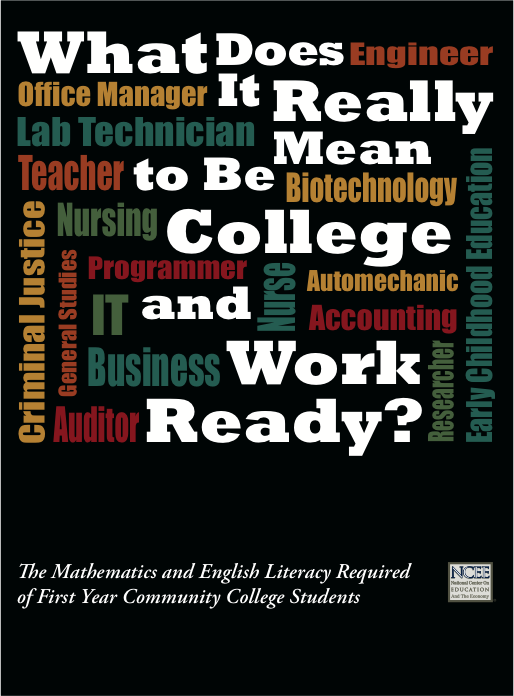
students need? In 2013, the National Center on Education and the Economy
released a study What Does It Really Mean to Be College and Work Ready?, reporting on both mathematics and English
literacy. The report says, "Mastery of Algebra II is widely thought to be
a prerequisite for success in college and careers. Our research shows that that
is not so... Based on our data, one cannot make the case that high school
graduates must be proficient in Algebra II to be ready for college and
careers."
California's
Intersegmental Committee of the Academic Senates (ICAS) represents the faculty
academic senates of the three CA systems of higher education: the University of
California (UC), the California State University (CSU), and the California
Community College (CCC) system. The ICAS Statement on Competencies in Mathematics Expected of Entering College Students,
revised in 2013, describes a number of mathematical topics that are or could be
taught in high schools.
The ICAS competency
statement describes mathematical subject matter in four categories: Part 1:
Essential areas of focus for all entering college students, Part 2: Desirable
areas of focus for all entering college students, Part 3: Essential areas of
focus for students in quantitative majors, and Part 4: Desirable areas of focus
for students in quantitative majors.
The mathematics that
the CCSSM describe as what all students need should presumably match with what
the ICAS statement describes as "essential" and lists in Part 1. But although the UC
Board of Admissions and Relations with Schools (BOARS) states there is "close
alignment" between the CCSS and the ICAS statement, the ICAS statement
makes clear that there are many CCSS that are not "essential" but
rather merely desirable or for only some students. Appendix B of the ICAS
statement explicitly shows where Part 2, 3, and 4 areas of math are found in the
CCSS (and NCTM standards).
And the Interim Environmental Scan Report to The Common Assessment Initiative Steering Committee has in Appendix B a Table that shows a number of CCSS that do not
occur at all in the ICAS statement.
Here are examples of
CCSSM topics that might surprise some community college math faculty,
especially those who believe that intermediate algebra as currently taught
will be sufficient to cover all the CCSSM.
- Probability: sample spaces, independent events, conditional probability, permutations and combinations; analyzing decisions and strategies using probability
- Statistics: assessing the fit of a function by plotting and analyzing residuals; interpreting the correlation coefficient of a linear model in context; normal distributions, random samples, estimating population parameters, simulations, using probability to make decisions
- Transformational geometry: congruence defined in terms of rigid motion; similarity defined in terms of dilations and rigid motions
- Trigonometry: trig ratios, special angles, 6 trig functions of real numbers; modeling periodic phenomena, proof and use of the Pythagorean trig identity \( \cos^2 \theta + \sin^2 \theta = 1 \)
Tuesday, July 29, 2014
Schizophrenic Common Core Supporter
Back in 2012 Sol Garfunkel wrote "I feel like a schizophrenic. I truly think that the Common Core State Standards for Mathematics (CCSSM) are a disaster...So why do I feel like a schizophrenic? Because I am at the same time working to make the implementation of the CCSSM be as effective as possible!"
As mathematician Keith Devlin has emphasized, the heart of the CCSSM is the set of 8 standards of Mathematical Practice:
- MP1. Make sense of problems and persevere in solving them.
- MP2. Reason abstractly and quantitatively.
- MP3. Construct viable arguments and critique the reasoning of others.
- MP4. Model with mathematics.
- MP5. Use appropriate tools strategically.
- MP6. Attend to precision.
- MP7. Look for and make use of structure.
- MP8. Look for and express regularity in repeated reasoning.
It would be hard to imagine that any mathematician or math educator would not applaud these standards. And these standards, the key to the CCSSM and presented at the start of each set of grade level standards, are rarely if ever mentioned in the attacks on the CCSSM.
Much of the resistance to the CCSS is political: the Democratic President of the United States has endorsed the CCSS, so there is automatic opposition from the Tea Party, Republicans, and Libertarians, who argue that the CCSS is a federal program. But although President Obama is giving incentives for states to adopt the CCSS, the standards are the result of 48 state governors and secretaries of education agreeing to cooperate to create educational standards that would be consistent across state lines.
The resistance from the classroom teachers is understandable because they will be held accountable to how their students will do on the CCSS standardized testing. But the standardized testing that will be used is not part of the CCSS but rather is being created by SBAC or PARCC, consortia created to write CCSS assessments. That is, although the news media report teacher opposition to the CCSS, the teachers' actual objection is to the assessments and how they will be used.
The widely seen mocking and vilification of CCSS lessons by the public also confuse the CCSS with methods for testing students for mathematical proficiency. The CCSS explicitly require that students master the standard algorithms that critics mistakenly say are "real math" and missing from the CCSS. But significantly, the CCSS also require (MP1) that students can make sense of the mathematical tasks they are performing.
I think the CCSSM grossly overshoot the mark when trying to specify the math that all students need to be college and career ready. But like Sol Garfunkel, I think we should simultaneously embrace the CCSS and work to improve them.
Wednesday, July 23, 2014
Common Core Goes to College
The New America
Foundation’s position paper by Lindsey Tepe gives recommendations for how higher education can support the Common Core
State Standards. However, this paper and related articles in the Chronicle and Hechinger Report miss the most important way for higher education to support the CCSS, namely,
to work to repair or ameliorate the existing flaws in the CCSS.

An implicit
assumption in Tepe's paper is that the CCSS have successfully captured what all
students need to be college and career ready. If the assumption is false, the paper is advocating moves to change higher education
to accommodate inappropriate standards, changes that could harm students and impede their
paths to college degrees.
The CCSS have
missed the mark at what is necessary for all students to succeed in college.
Many of the non-plus
CCSS are currently introduced to students in credit-bearing courses of
baccalaureate granting institutions. That is, the CCSS overshoots what is
needed to be ready for college and includes topics that are part of what some
college students need to learn while in college.
Thursday, July 17, 2014
Math Initiatives for Student Success
The LearningWorks paper Changing Equations: How Community Colleges Are Re-thinking College Readiness in Math,
written by Pamela Burdman, is a nice summary of current initiatives attempting
to help capable students negotiate developmental math needs to succeed in
transfer-level mathematics.


Much of the paper discusses the strategy of alternative
pathways. In this strategy, students pass a course that is identical to, or has
the same content and rigor of, accepted transfer math courses, but instead of first
passing an intermediate algebra course, the students take a math course designed
specifically to prepare them for the transfer course—that preparatory course omits
some standard topics of intermediate algebra which are not necessary to succeed
in the transfer math course.
The initial data on alternative pathways, some cited in Changing Equations, show that a much higher percentage of students initially placed in a developmental math course can pass a transfer level math course following an alternative pathway than by following the traditional chain of prerequisites.
But both the University of California and the California State University systems require that intermediate algebra be a prerequisite for any transferable course. Keeping the intermediate algebra prerequisite based on the data
that have shown success in intermediate algebra is a predictor of college success
is, as pointed out in Changing Equations,
following the error of confusing correlation with causation, and in fact the
widespread practice of requiring success in intermediate algebra (a.k.a.
Algebra 2) as a admissions requirement virtually guarantees the high
correlation that has been often noted.
Sunday, January 19, 2014
JMM 2014
Over 6400
mathematicians descended upon Baltimore January 15-18 for the 2014 Joint
Mathematics Meetings. Sessions included current research in math, discussions
on pedagogy, content, collaborations across institutions, social events, and
more.
The first session on
Wednesday 15 January was the MAA Minority Chairs committee meeting at 7:00 am,
although there were actually some short courses, workshops, AMS council
meetings and MAA Board of Governors meeting on the preceding Monday and
Tuesday. And there were dozens of contributed paper sessions throughout the
morning and the rest of the day.
The JMM unveiled the
theme of the 2014 Math Awareness Month (April 2014): Mathematics, Magic, &
Mystery (http://www.mathaware.org/). On
each day of April 2014 a new square of the Activity Calendar goes live, giving
access to mathematical puzzles and magic. (Once opened, the resources are to be
kept available for as long as the AMS exists.)
JMM2014 also
included a panel session launching TPSE Math: Transforming Post-Secondary
Education in Mathematics (@tpsem, http://www.tpsemath.org/).
The project is sponsored by the Carnegie Foundation of New York and the Alfred
P. Sloan Foundation.

One of the sessions
on the last day was The Public Face of Mathematics http://blogs.ams.org/jmm2014/2014/01/18/the-public-face-of-mathematics/. The panel was organized by mathemagician Art Benjamin (http://www.math.hmc.edu/~benjamin/) and included "Math Guy" Keith Devlin (http://www.stanford.edu/~kdevlin/), NY Times columnist Steven Strogatz (http://www.stevenstrogatz.com/), mathbabe Cathy O'Neill (http://mathbabe.org/), freelance journalist Tom Siegfried (http://www.sciencenoise.org/), and US Congressman Jerry McNerny (http://mcnerney.house.gov/).
Friday, July 26, 2013
More on Alternative Pathways and transferability in California
California's
adoption of the Common Core State Standards in Mathematics (CCSSM) helps to
shape the expectations of universities regarding the mathematical background of
their incoming students.
The July 2013
statement (http://senate.universityofcalifornia.edu/committees/boars/BOARSStatementonMathforAllStudentsJuly2013.pdf)
from the University of California's Boards of Admissions & Relations with
Schools (BOARS) comments that most California Community Colleges (CCCs)
continue to use "traditional Intermediate Algebra (i.e., Intermediate
Algebras as defined prior to CCSSM implementation)" as prerequisite to a
transferable mathematics course.
The BOARS statement
continues, "Specifying that transferable courses must have at least
Intermediate Algebra as a prerequisite is not fully consistent with the use of
the basic mathematics of the CCSSM as a measure of college
readiness...Requiring that all prospective transfer students pass the current
version of Intermediate Algebra would be asking more of them than UC will ask
of students entering as freshmen who have completed CCSSM-aligned high school
math courses. As such, BOARS expects that the Transferable Course Agreement
Guidelines will be rewritten to clarify that the prerequisite mathematics for
transferable courses should align with the college-ready content standards of
the CCSSM."
Meanwhile, the
Academic Senate of California Community Colleges (ASCCC) has endorsed the
CCSSM, but has no formal position on alternative pathways. A Fall 2012 resolution to support innovations to improve success in under-prepared non-STEM pathways was referred to the
executive committee. However, former
ASCCC president Ian Walton did publish in the ASCCC Rostrum an opinion (http://asccc.org/content/alternatives-traditional-intermediate-algebra)
that "The wide range of conversations demonstrates that a strong case can
be made for the exploration and implementation of alternative preparations for
transfer level math courses that differ from the content of the traditional
intermediate algebra course."
Sunday, July 21, 2013
Alternative Pathways and transferability in California
California is home
to the Carnegie Foundation for the Advancement of Teaching, the current force
behind two pathway projects: Statway and Quantway.
An
underlying assumption behind alternative pathways is that mathematics requirements for degrees and/or certificates should
vary according to discipline. California's Student Success Task Force report contends, "Improved student support structures
and better alignment of curriculum with student needs [Emphasis added] will increase success rates in transfer, basic skills,
and career technical/workforce programs." The National
Center on Education and the Economy 2013 report, "What Does It Really Mean to Be College and Work Ready?" states, "But our research...shows that
students do not need to be proficient in most of the topics typically
associated with Algebra II and much of Geometry to be successful in most
programs offered by the community colleges."
The
Carnegie Foundation, The Charles A. Dana Center at U.T. Austin, and the California Community College Success
Network (3CSN) all promote alternative pathways
to allow students in non-STEM disciplines an option of completing a
university-transferable mathematics course without requiring the students to
demonstrate completion of an intermediate algebra course.
The two California
university systems, the University of California (UC) and the California State
University (CSU) have been cautious in embracing the idea of alternative
pathways in California Community Colleges (CCCs).
One pathway strategy
is to provide students with an alternative
prerequisite to an existing transferable statistics class. The alternative prerequisite does not have
all traditional intermediate algebra topics and does not have elementary algebra
as prerequisite. And in response to this strategy, Nancy Purcille of the UC
Office of the President sent a March 7, 2013 email to CCC articulation
officers:
"The
prerequisite for UC-transferable math courses continues to be intermediate
algebra or equivalent. No attempt at this time will be made by UC to
define specific content/courses that may be deemed “valid” alternate
prerequisites. When submitting a course for TCA review, if CCC faculty
propose a prerequisite that they judge to be the equivalent of intermediate
algebra, then UCOP articulation analysts will treat the prerequisite as such
and evaluate the course outline as usual. UC will not be evaluating the
prerequisites listed – unless it is jointly requested by the CCC and UC
faculty."
This position
appears to respect the tenet that the community college should be able to
decide the appropriate developmental math required to prepare its students for
the articulated transfer-level math course.
The CSU provided a
different position to accommodate alternative pathways. Ken O'Donnell of the CSU Office of the
Chancellor sent a November 2, 2012 email to CCC articulation officers that appeared to be discouraging alternative pathways:
"Please
take this email as a reminder that only courses with a full prerequisite of
intermediate algebra, as traditionally understood, will continue to qualify for CSU Area B4 [math/quantitative
reasoning requirement to transfer].
"The
CSU has made a recent exception for the Statway curriculum, under controlled
and very limited circumstances, so we can evaluate whether other approaches
will satisfactorily develop student proficiency in quantitative
reasoning. In the meantime, we count on the articulation community to
uphold the current standard."
But Ken O'Donnell
sent an April 2013 email acknowledging without objection the strategy of keeping
the intermediate algebra the official prerequisite for the transfer math course
but facilitating CCC student challenges to that prerequisite.
The
CSU Chancellor’s General Education Advisory Committee has looked into this use
of the prerequisite challenge process, and determined that it has no grounds to
comment. How community colleges meet curricular requirements that are
below baccalaureate level is up to the colleges, and not up to the receiving
transfer institutions. In other words, community colleges may participate
in initiatives like Acceleration in Context and the California Acceleration
Project without jeopardizing articulation, because the transferable B4 course
is unchanged; only the intermediate algebra prerequisite is challenged.
Thus both the UC and
the CSU are tacitly giving CCCs the go-ahead to develop alternative pathways.
Thursday, March 28, 2013
Heron's formula for the area of a triangle

The angle bisectors
of the triangle meet at the center of the inscribed circle of radius r. If we let \(2\alpha=A\), \(2\beta = B\), and \(2\gamma=C\), we have \(\alpha+\beta+\gamma=\frac{\pi}{2}\).
Let x be the distance from the vertex at A to points of tangency, y the distance from B, and z the distance from C. Then then lengths of the triangle sides opposite A, B, and C are respectively \(a=y+z\), \(b=x+z\), and \(c=x+y\).
Thus if we name the semiperimeter s, then \(s=x+y+z\), \(x=s-a\), \(y=s-b\), and \(z=s-c\).
Thus if we name the semiperimeter s, then \(s=x+y+z\), \(x=s-a\), \(y=s-b\), and \(z=s-c\).
\(\tan \alpha =\frac{r}{x}\), \(\tan \beta =\frac{r}{y}\), and \(\tan \gamma =\frac{r}{z}\). Because \(\gamma\) and \( (\alpha+\beta )\) are complementary angles, we
obtain
\[ \tan\left( \frac{\pi}{2} - (\alpha+\beta) \right) = \frac{r}{z} \]
\[ \tan\left( \alpha+\beta \right) = \frac{z}{r} \]
\[ \frac{ \tan \alpha+\tan\beta}{1-\tan\alpha \tan\beta} = \frac{z}{r} \]
\[r \left(\tan \alpha+\tan\beta \right)= z (1-\tan\alpha\tan\beta) \]
\[r \left( \frac{r}{x}+\frac{r}{y} \right) = z \left( 1 - \frac{r}{x}\frac{r}{y} \right) \]
\[ r^2 y + r^2 z = xyz - r^2 z \]
\[ r^2 ( x+y+z) = xyz \]
\[ r^2 s = xyz \]
The radii at the
points of tangency and the angle bisectors form 3 pairs of congruent
triangles. The area of \(\Delta ABC\) is \(xr+yr+zr= r(x+y+z)\), so area \(=rs\), and \( (\text{area})^2=r^2s^2\). Using results we have above, we
obtain
\[ (\text{area})^2 = s\cdot xyz = s(s-a)(s-b)(s-c)\]
so the area is \(\sqrt{s(s-a)(s-b)(s-c)}\).
\[ (\text{area})^2 = s\cdot xyz = s(s-a)(s-b)(s-c)\]
so the area is \(\sqrt{s(s-a)(s-b)(s-c)}\).
Wednesday, January 16, 2013
Contradictory mandates to community colleges
A goal of the Common
Core State Standards (CCSS) is to prepare students to be college and career
ready. That goal is also part of the
mission of community colleges. There has
been considerable discussion regarding how
the CCSS might affect students' chances for getting into college, but
scant discussion about how community colleges fit into the implementation of
the CCSS.
Community Colleges
might be assumed to have a distorted view of what it means to be college or
career ready. After all, they typically
use the word "college" when naming themselves, yet eligibility to become
a community college student does not require any minimum GPA nor any minimum
score or ranking in any test. It is
sometimes said that the University of California serves the top 12.5% of
California high school graduates, the California State University system the
top 33.3%, and the California Community Colleges serve the top 100%. But this is too limiting--a high school
diploma is not a requirement for enrollment at any California Community
College.
So at community
colleges, we may worry less about "college ready" but rather focus on
"transfer ready". UCLA and
CSUN are my school's two nearest public universities, and both report that our
transfer students perform slightly better than their native students. So there is evidence that community colleges
are not grossly underestimating what is needed to be transfer ready.
California Community
Colleges are presented with two conflicting mandates . Community colleges are encouraged 1) to align with K-12
standards for college and career readiness (according to the California
Community College Student Success Task
Force http://bit.ly/xOC5aK),
and 2) to provide alternative pathways
to transfer (according to the Carnegie Foundation for the Advancement of
Teaching http://bit.ly/y1EZhX,
the Charles A. Dana Center http://www.utdanacenter.org/mathways/,
etc.).
Explicitly, a
consortium of the Charles A. Dana Center, Complete College America, Inc.,
Education Commission of the States, and Jobs for the Future, asks community
colleges to provide a
"fundamentally new approach for ensuring that all students are
ready for and can successfully complete college-level work that leads to a
postsecondary credential of value.
"...The content
in required gateway courses should align with a student’s academic program of
study — particularly in math... Institutions need to focus on getting students
into the right math and the right English." (from "Core Principles
for Transforming Remedial Education: A Joint Statement" : http://bit.ly/TPqqCp)
The researcher at my
institution estimated that 75% of our students interested in transfer are in
disciplines that require no mathematics beyond an introductory statistics class
to earn a baccalaureate degree at CSUN.
Evidently there are many students who can earn baccalaureate degrees
without taking single course from the
mathematics department of any 4-year school.
The California
Community College Success Network (3CSN.org), the Carnegie Foundation, the Dana Center, and the
Student Success Task Force all recommend removing curricular requirements that act as barriers rather than aids to
program completion. The SSTF report
contends, "Improved student support structures and better alignment of curriculum with student needs will
increase success rates in transfer, basic skills, and career
technical/workforce programs." [emphasis added]
The existing and
proposed curricula of alternative pathways for non-STEM students omit many
topics of intermediate algebra.
On the other hand,
neither the University of California nor the California State University
accepts a math or statistics course to meet
math transfer requirements unless that course has intermediate algebra
as a prerequisite.
If aligning with the
CCSS implies that "intermediate algebra" should mean CCSS Algebra 2
(which includes circular trig and some inferential statistics), then the math
requirements for transfer math courses will increase significantly.
And because
intermediate algebra is the California Community College minimum math requirement for an associate's
degree, the requirement for an AA degree will also increase simultaneously.
It is impossible for
community colleges to remove unnecessary but currently required topics (for transfer to non-STEM disciplines) while
simultaneously not merely maintaining but augmenting that list of required
topics for all students.
Thursday, December 20, 2012
Alternative Pathways vs Common Core State Standards
A primary goal of
the Common Core State Standards (CCSS) is to provide a curriculum to ensure
that all high school graduates are college and career ready. The CCSS math topics through grade 11 include not only
all of the topics of the traditional U.S. Algebra 1-Geometry-Algebra 2
sequence, but also topics typically taught in courses named trigonometry and
statistics.
Alternative pathways
provide a means for non-STEM (i.e., non- Science, Technology, Engineering, and
Math) students to transfer from a two-year college to a four-year institution
and earn a bachelor's degree without needing to show mastery of traditional intermediate
algebra topics. The promotion of alternative pathways challenges the premise
that the CCSS for math are needed for all
students to be college ready.
The common goal of both alternative pathways and the CCSS is to improve U.S. education.
"Core Principles for Transforming Remedial Education: A Joint Statement" from the Charles A. Dana Center,
Complete College America, Inc., Education Commission of the States, and Jobs
for the Future, calls for revamping the two-year college remediation
structure. The paper lists seven Core
Principals for a "fundamentally new approach for ensuring that all
students are ready for and can successfully complete college-level work that
leads to a postsecondary credential of value.
"...Principle 2.
The content in required gateway courses should align with a student’s academic
program of study — particularly in math.
"Gateway
courses provide a foundation for a program of study, and students should expect
that the skills they develop
in gateway courses are relevant to their chosen program. On many campuses, remedial education
is constructed as single curricular pathways into gateway math or English
courses.
"The curricular
pathways often include content that is not essential for students to be
successful in their chosen program of
study. Consequently, many students are tripped up in their pursuit of a
credential while studying
content that they do not need. Institutions need to focus on getting students
into the right math and the
right English.
"This issue is
of particular concern in mathematics, which is generally considered the most
significant barrier to college
success for remedial education students. At many campuses, remedial math is
geared toward student
preparation for college algebra. However for many programs of study, college
algebra should not be a
required gateway course when a course in statistics or quantitative literacy
would be more appropriate….
"...One final
note: Postsecondary leaders must work closely with K–12, adult basic education,
and other training
systems to reduce the need for remediation before students enroll in their
institutions. Postsecondary
institutions should leverage the Common Core State Standards by working with
K–12 schools to improve
the skills of their students before they graduate from high school. Early
assessment of students in high school, using existing placement exams and
eventually the Common Core college and career readiness
assessments, which lead to customized academic skill development during the
senior year, should be a
priority for states. Similar strategies should be employed in adult basic
education and English as a second
language programs."
Subscribe to:
Posts (Atom)